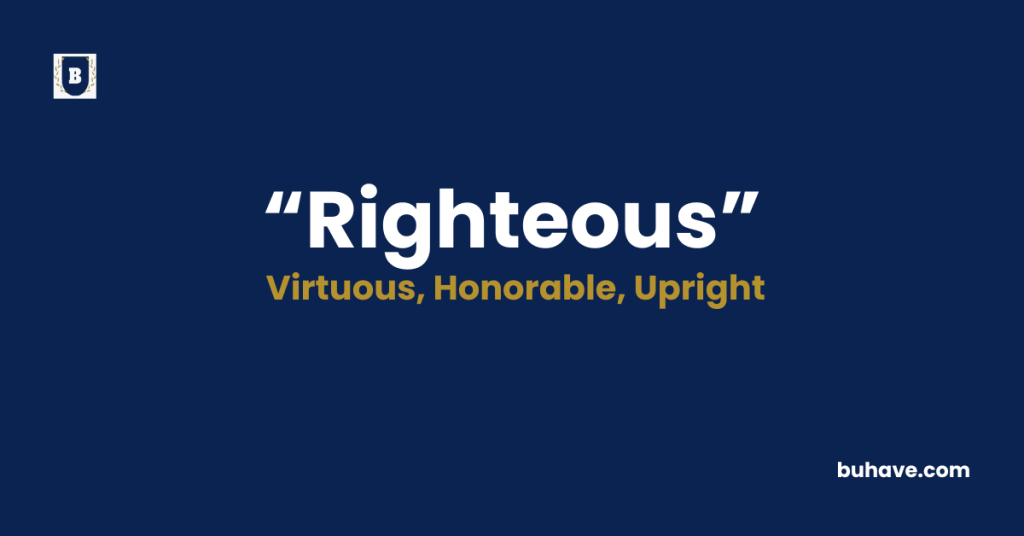
The word ‘Righteous’ (adjective) describes a person or action that is morally right and ethically sound. In this guide, you’ll learn the full definition, synonyms, antonyms, etymology, and real-life examples of how to use ‘Righteous’ correctly in sentences.
Righteous Explained in Depth
A complete and detailed guide to the words Righteous, including meaning, definition, examples, etymology, synonyms, and antonyms.
Meanings of Righteous
Righteous is a powerful word used to describe behavior or character that aligns with what is morally right, ethical, or spiritually pure. A righteous person consistently chooses to do the right thing, even when it’s difficult, and is often guided by a deep sense of justice, honesty, and compassion. It goes beyond merely following rules; it implies living with integrity and doing what is ethically sound from within. Depending on context, it can also describe a decision or outcome viewed as deserved or just—similar in meaning to words like rightful.
Definition
People often use the term righteous to talk about moral or spiritual behavior, particularly in religious or philosophical contexts. For instance, a righteous leader is one who treats others fairly, governs justly, and holds themselves to high moral standards. It can also describe actions: for example, a “righteous decision” might refer to a choice made with compassion, justice, and ethical reasoning.
It implies a consistent commitment to moral integrity, fairness, and the pursuit of what is ethically right—often in a religious, personal, or societal context. If you want a closely related adjective for describing upright character, see upright.
Etymology
The word “righteous” has deep historical and linguistic roots. It comes from Middle English riȝtwis or riȝtwouse, meaning “just” or “morally right,” which evolved from Old English rihtwīs. This Old English term is a combination of riht (right, just, proper) and wīs (wise or manner). In other words, “righteous” originally conveyed the idea of being wise in what is right or living in a right manner.
Despite evolving usage, its root idea of doing what is morally and ethically right remains central.
Example Sentences
- In every decision, he strives to be fair and righteous, even under pressure at work.
- The community honored her as a righteous person who helped neighbors selflessly during a crisis.
- Her righteous anger about injustice inspired others to speak up at the hearing.
- He led a righteous life, guided by compassion, humility, and faith.
Righteous Synonyms
Righteous Antonyms
- Immoral
- Wicked
- Dishonest
- Corrupt
- Sinful
- Unethical
- Depraved
- Wrong
- Evil
- Unjust
FAQs about Righteous
Here are some frequently asked questions (FAQs) about the word “Righteous.”
1. Is “righteous” always religious?
Not necessarily. While “righteous” has strong religious associations, especially in Judeo-Christian traditions, it is also commonly used in secular contexts to mean morally right, just, or ethical.
2. What’s the difference between “righteous” and “virtuous”?
Both describe strong moral character, but “righteous” often emphasizes justice and adherence to moral or divine laws. “Virtuous” is broader and focuses more on overall goodness and noble character traits. For a deeper comparison, see virtuous.
3. Can “righteous” describe an action, not a person?
Yes. You can use “righteous” to describe decisions, choices, or causes that are viewed as morally right—for example, a “righteous cause” or “righteous decision.”
4. Is there a word closer to “deserved punishment” than “righteous”?
If you mean punishment that is considered morally deserved, the term retribution is often a better fit than righteous.
Explore More R Words
- Positive words that start with R
- Negative words that start with R
- Adjectives words that start with R
- Nouns that start with R
- Verbs that start with R