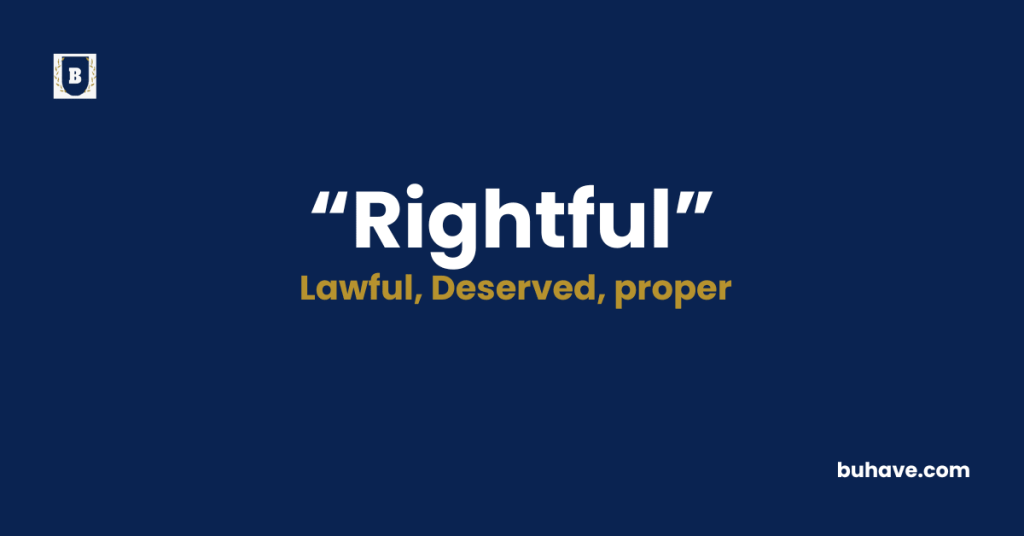
The word ‘Rightful’ (adjective) refers to something that is morally or legally correct—fair, proper, and just. It can also describe entitlement to a role, position, or outcome based on justice, law, or natural fairness. In this guide, you’ll discover the full meaning, expanded definition, fascinating etymology, helpful examples, synonyms, antonyms, and frequently asked questions to understand and use “Rightful” accurately in both formal and everyday contexts.
Rightful Explained in Depth
A complete and practical guide to the word Rightful, including meaning, definition, etymology, example sentences, synonyms, and antonyms for clear writing.
Meanings of Rightful
Rightful is used to describe something that is deserved, legitimate, or in accordance with justice, morality, or established law. When someone refers to a “rightful owner,” they mean the person who legally or ethically deserves something. The term can also describe actions, roles, or claims that are just and proper.
This word often carries a strong sense of fairness and correctness. For example, if a king reclaims his throne after being exiled, he may be called the “rightful ruler,” suggesting that he has a just claim to that position. It also appears in everyday situations: someone might demand their “rightful share” of an inheritance, meaning the portion they’re fairly entitled to receive.
If you’re looking for a closely related idea, you may also like the meaning of worthy, since both words describe value and entitlement—though rightful focuses more on correctness and justice.
Definition
Rightful combines legal legitimacy with ethical fairness, making it useful in legal, historical, moral, and even emotional discussions. Whether you’re referring to justice in a courtroom, fairness in a family decision, or correctness in a moral judgment, “rightful” suggests integrity and validity.
In short, it affirms that something belongs to someone—or should happen a certain way—because it matches justice, law, or natural entitlement. Related verbs like rectify are often used when people try to restore something rightful after it has been distorted.
Etymology
The word “rightful” is derived from the root word “right,” which traces back to Old English riht, meaning “just, good, fair, proper, or correct.” This Old English term comes from the Proto-Germanic *rekhtaz, and ultimately connects to the Latin word rectus, which also means “straight” or “right” (as in morally upright or correct).
The suffix “-ful” was added in Middle English to form “rightful,” creating a descriptive adjective meaning “full of right” or “characterized by justice and fairness.” Over time, “rightful” became widely used to describe claims, actions, and identities validated by moral or legal standards.
Its usage remains especially common in legal and literary contexts, often emphasizing legitimacy, fairness, and moral authority—such as in phrases like “rightful heir.”
Example Sentences
- He is the rightful heir to the throne, according to the royal bloodline.
- She demanded her rightful place in the discussion, having worked on the project since the beginning.
- The court ruled in favor of the rightful owner of the stolen artwork.
- They finally received rightful recognition for their efforts in the community.
- It’s only fair that she be treated as the rightful winner of the contest.
- The company agreed to rectify the billing error and restore what was rightful to the customer.
Rightful Synonyms
- Honorable
- Legitimate
- Just
- Deserved
- Entitled
- Lawful
- Honest
- Valid
- Proper
- Fair
Rightful Antonyms
- Unjust
- Illegitimate
- Wrongful
- Unlawful
- Improper
- Undeserved
- False
- Dishonest
- Invalid
- Inappropriate
FAQs about Rightful
Here are some frequently asked questions (FAQs) about the word “Rightful.”
1. What does “rightful” mean in a legal context?
In legal terms, “rightful” refers to someone or something that has a legitimate claim under the law—such as a rightful owner or rightful heir. It implies that the claim is supported by evidence, documentation, or established precedent.
2. Is “rightful” always about ownership?
No. While it’s often used for rightful ownership, it can also describe rightful actions, roles, or recognition based on fairness or justice—such as “rightful decision” or “rightful place” in a team.
3. Can “rightful” be used in everyday language?
Yes. It has a slightly formal tone, but it still appears in everyday speech, for example: “She took her rightful place on the team,” or “That was his rightful reward after working late every day.”
4. Is “rightful” the same as “legal”?
Not exactly. “Legal” focuses strictly on what the law says. “Rightful” can also include moral and ethical dimensions. A situation can be legal but not feel rightful in a moral sense—and a situation can be morally rightful even when the legal outcome is still uncertain.
5. What’s the opposite of “rightful”?
Common antonyms include “wrongful,” “illegitimate,” “unjust,” and “undeserved.” These words suggest that the claim or action lacks fairness, legal backing, or moral correctness.