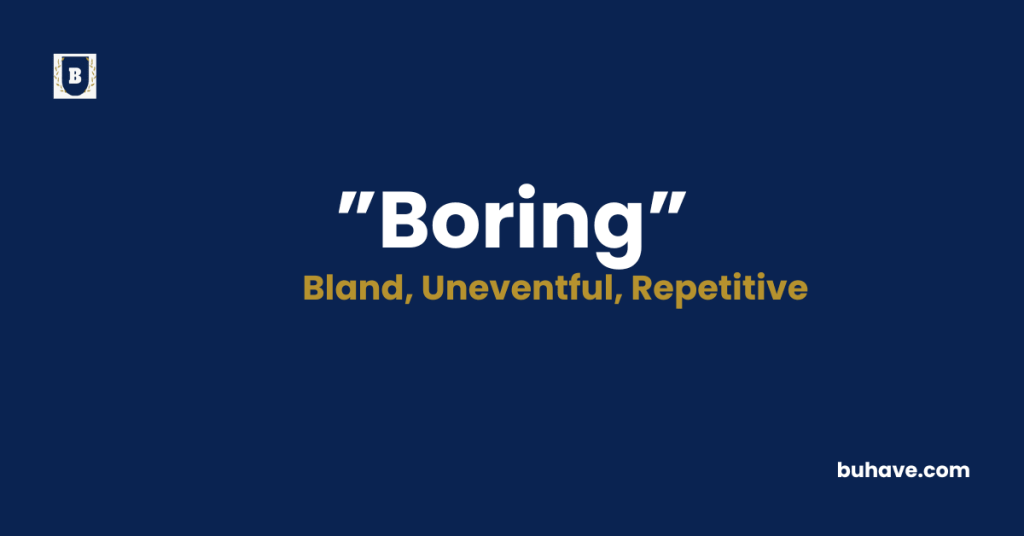
The word Boring (adjective) describes something that lacks interest, excitement, or stimulation, often making it feel dull or tiresome. In this guide, you’ll learn the full definition, synonyms, antonyms, etymology, and real-life examples of how to use boring correctly in sentences.
Boring Explained in Depth
A complete and detailed guide to the word Boring including meaning, definition, examples, etymology, synonyms, and antonyms.
Meanings of Boring
Boring means uninteresting or tedious to the point that it causes disinterest, restlessness, or fatigue.
Definition
Boring refers to something that is so dull or uninteresting that it fails to capture attention or stimulate curiosity. It can describe people, tasks, stories, meetings, classes, or experiences that lack engagement, variety, or emotional pull.
Etymology
The word boring comes from the verb “bore”, meaning to make someone weary or tired through dullness. It traces back to the early 18th century in the sense of “to bore someone” — to tire them out with something that is repetitive, unexciting, or lacking in interest. (Today, it’s also used as the participle of “bore” in other senses, such as “a boring machine”.)
Example Sentences
- The lecture was so boring that several students started checking their phones.
- He quit the job because he found the work boring and repetitive, with little room to grow.
- They left the party early because the conversation turned boring and predictable.
Boring Synonyms
- Dull
- Tedious
- Uninspiring
- Mundane
- Dullness
- Uninteresting
- Monotonous
- Dry
- Repetitive
- Stale
Boring Antonyms
- Exciting
- Interesting
- Engaging
- Captivating
- Thrilling
- Lively
- Fascinating
- Stimulating
- Entertaining
- Intriguing
FAQs about Boring
Here are some frequently asked questions about the word “Boring”
1. What does “boring” actually mean?
It means something that is so uninteresting or dull that it causes disinterest, impatience, or tiredness.
2. Can people be boring?
Yes. A person who doesn’t engage others, offers little variety, or doesn’t seem enthusiastic can be described as boring.
3. Is “boring” always a negative term?
Usually, yes. It typically implies something lacks excitement or feels unpleasantly dull. In some contexts, it can also be used lightly or humorously, depending on tone.
4. Is “boring” subjective?
Yes. What one person finds boring, another might find interesting. Context and personal preferences play a big role.
5. What’s the difference between “boring” and “tedious”?
“Boring” describes a lack of interest, while “tedious” often emphasizes long, repetitive, slow work that feels draining. For example, a task can be boring because it’s dull, and also tedious because it takes forever.