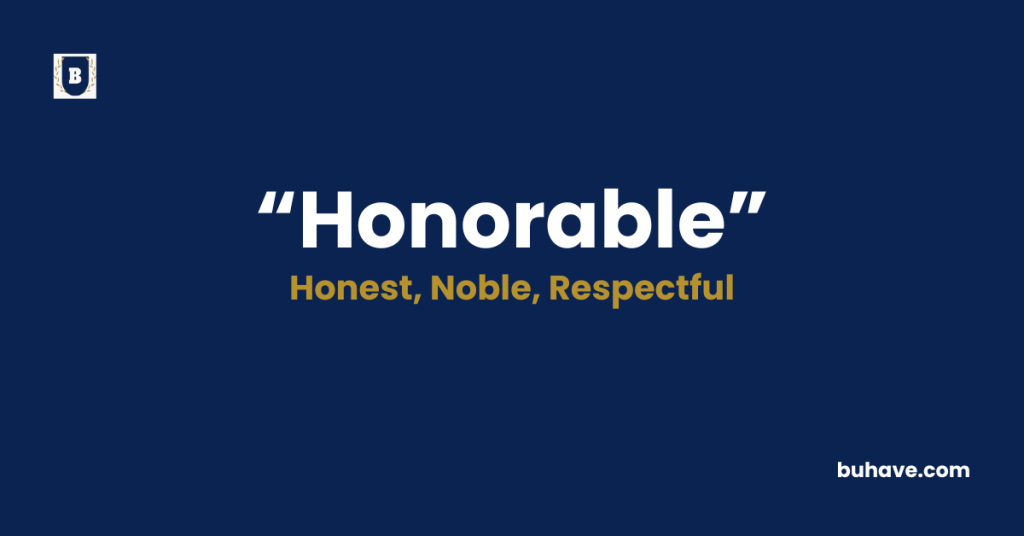
The word ‘Honorable’ (adjective) describes a person or action that deserves respect because it follows high moral standards, demonstrates honesty, and reflects fairness. In this guide, you’ll learn the full definition, synonyms, antonyms, etymology, and real-life examples of how to use ‘honorable’ correctly in sentences.
Honorable Explained in Depth
A complete and detailed guide to the word honorable, including meaning, definition, examples, etymology, synonyms, antonyms, and common ways to use it in everyday, professional, and formal writing.
Meanings of Honorable
Honorable means showing strong moral character and acting with honesty, fairness, and respect toward others. At first, people may recognize an honorable person by the way they keep their promises and treat everyone with dignity. In addition, being honorable involves making difficult decisions that are guided by ethical values rather than selfish interests. Moreover, honorable individuals often earn trust over time because they consistently demonstrate integrity.
Eventually, their reputation grows stronger as their actions continue to reflect loyalty, responsibility, and kindness. Today, in a world full of challenges and temptations, people who live honorably can influence others to do the right thing even when it is difficult.
Definition:
Honorable describes a person or action that deserves respect because it follows high moral standards, demonstrates honesty, and reflects fairness. At first, honorable behavior often appears in everyday acts like telling the truth, owning mistakes, or keeping a promise. In addition, it involves standing up for what is right, even when it may not be easy or popular. Moreover, an honorable person consistently chooses actions that benefit others, not just themselves. Eventually, living honorably builds stronger relationships, lasting trust, and a reputation for good character.
In formal contexts, you may also see honorable used as a title or style (for example, “The Honorable” in court), which signals a position of public respect.
Etymology:
The word “honorable” comes from the Old French word “honorable,” which meant “worthy of honor” or “respectable.” At first, this French term was based on the Latin word “honorabilis,” meaning “worthy of honor,” and that, in turn, came from “honor,” meaning “honor” or “esteem.” In addition, when English speakers adopted the word (in the 14th century), they used it to describe people or actions that deserved admiration and respect. Moreover, as society developed, the idea of being honorable became closely tied to living by strong ethical principles and showing fairness to others.
Eventually, the term broadened to describe deeds, titles, and positions that command high regard. Today, people continue to use it to recognize those who consistently act with integrity, courage, and a clear sense of right and wrong.
Example Sentences:
- At first, she earned respect in her community because she always made honorable choices, even when they were difficult.
- In addition, an honorable leader admits mistakes, explains what changed, and corrects the problem, setting a strong example.
- Moreover, people view acts of kindness and fairness as honorable because they reflect real moral values, not just words.
- Eventually, his honorable service in public life earned him admiration from both colleagues and neighbors.
- Today, many people believe an honorable life matters more than achieving fame or fortune.
Honorable Synonyms:
Honorable Antonyms:
- Dishonorable
- Corrupt
- Unethical
- Immoral
- Deceitful
- Disreputable
- Unprincipled
- Shady
- Indecent
- Wicked
FAQs about Honorable
Here’s a FAQ-style guide about the word “Honorable” and how to use it accurately.
1. What does “honorable” mean?
“Honorable” is an adjective used to describe a person, action, or trait that is morally right, deserving of respect, and guided by integrity. It often implies honesty, fairness, and adherence to ethical principles.
2. How is “honorable” used in a sentence?
- “He made an honorable decision, even when it was difficult.”
- “Serving others selflessly is an honorable pursuit.”
- “The judge is addressed as ‘The Honorable’ in court.”
3. What are some synonyms for “honorable”?
- Noble
- Respectable
- Virtuous
- Upright
- Trustworthy
- Principled
These words all highlight a strong sense of moral integrity, though each one has a slightly different emphasis.
4. What is the opposite of “honorable”?
Opposites include:
- Dishonorable
- Shameful
- Deceitful
- Unethical
- Disgraceful
These describe actions or individuals that lack integrity or bring disrepute.
5. Is “honorable” used only for people?
No. While it is commonly used to describe people, it can also describe:
- Decisions (for example, “an honorable choice”)
- Professions or roles (for example, “an honorable career in public service”)
- Conduct (for example, “an honorable response to conflict”)
6. What is the origin of the word “honorable”?
“Honorable” comes from Latin honorabilis, meaning worthy of honor. In English, it has been used since the 14th century to describe dignified or ethical behavior.
7. Why is being honorable important?
Being honorable:
- Builds trust and respect
- Promotes ethical leadership
- Encourages fairness and justice
- Supports long-term credibility in communities and workplaces
It is a cornerstone of character and credibility.