
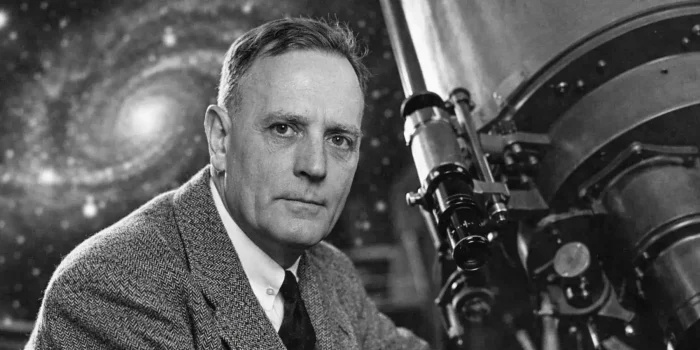
Edwin Hubble Biography: The Astronomer Who Changed Our Understanding of the Universe
Edwin Hubble was one of the most influential astronomers in history, best known for proving that the universe is expanding and that galaxies exist far beyond the Milky Way. His discoveries completely transformed modern astronomy and laid the foundation for cosmology as we know it today. Even decades after his death, Edwin Hubble’s work continues to shape space research, telescope technology, and our understanding of the cosmos.
Early Life and Education
Edwin Powell Hubble was born on November 20, 1889, in Marshfield, Missouri, USA. He grew up in a family that valued education and discipline. As a young student, Hubble showed exceptional talent in both academics and athletics, excelling in mathematics, science, and sports.
He earned his undergraduate degree in mathematics and astronomy from the University of Chicago. Later, as a Rhodes Scholar, he studied law at Oxford University in England. However, his passion for astronomy never faded, and he eventually returned to science to complete his PhD in astronomy at the University of Chicago.
Edwin Hubble’s Breakthrough Discoveries
Discovery of Galaxies Beyond the Milky Way
Before Edwin Hubble’s work, scientists believed the Milky Way was the entire universe. In the 1920s, using the powerful Hooker Telescope at Mount Wilson Observatory, Hubble discovered Cepheid variable stars in what were then called “nebulae.”
This discovery proved that these nebulae were actually separate galaxies, located millions of light-years away. As a result, the known size of the universe expanded dramatically.
Hubble’s Law and the Expanding Universe
Edwin Hubble’s most famous contribution is Hubble’s Law, which states that the farther a galaxy is from Earth, the faster it is moving away.
This observation provided the first strong evidence that the universe is expanding, which later became a key foundation for the Big Bang theory.
The Hubble Classification System
Edwin Hubble developed the Hubble Sequence, a system used to classify galaxies based on their shapes. This system divides galaxies into:
- Spiral galaxies
- Elliptical galaxies
- Irregular galaxies
The Hubble classification system is still widely used in astronomy today.
Edwin Hubble and World War I
Before achieving fame as an astronomer, Edwin Hubble served in World War I as a military officer. His service highlighted his leadership abilities and sense of responsibility. After the war, he returned to astronomy and began the work that would define his legacy.
The Hubble Space Telescope and His Legacy
Although Edwin Hubble died long before space telescopes existed, NASA honored his legacy by naming the Hubble Space Telescope after him. Launched in 1990, the telescope has provided some of the most detailed images of the universe ever captured.
The telescope continues to support groundbreaking discoveries and remains one of the most important scientific instruments in history.
Death and Personal Life
Edwin Hubble died on September 28, 1953, at the age of 63. He was a private individual and had no children. His family chose not to hold a public funeral, adding a quiet mystery to the life of a man who revealed the universe’s biggest secrets.
Edwin Hubble’s Importance Today
Edwin Hubble’s discoveries remain central to modern astronomy and cosmology. His work continues to influence:
- Modern cosmology research
- Space telescope missions
- Dark energy studies
- Galaxy formation theories
With discoveries from the James Webb Space Telescope, Hubble’s original ideas are still being tested and expanded.
Frequently Asked Questions (FAQs)
Who was Edwin Hubble?
Edwin Hubble was an American astronomer who proved that galaxies exist beyond the Milky Way and that the universe is expanding.
What is Edwin Hubble most famous for?
He is best known for discovering galaxies outside our own and for formulating Hubble’s Law.
Is the Hubble Space Telescope named after Edwin Hubble?
Yes, NASA named the Hubble Space Telescope in his honor.
Did Edwin Hubble win a Nobel Prize?
No, Edwin Hubble never won a Nobel Prize because astronomy was not a Nobel-recognized field during his lifetime.
Why is Edwin Hubble still important today?
His discoveries form the foundation of modern cosmology and continue to guide astronomical research.
Conclusion
Edwin Hubble was a visionary scientist whose discoveries reshaped humanity’s understanding of the universe. His work continues to inspire astronomers, scientists, and space enthusiasts around the world.