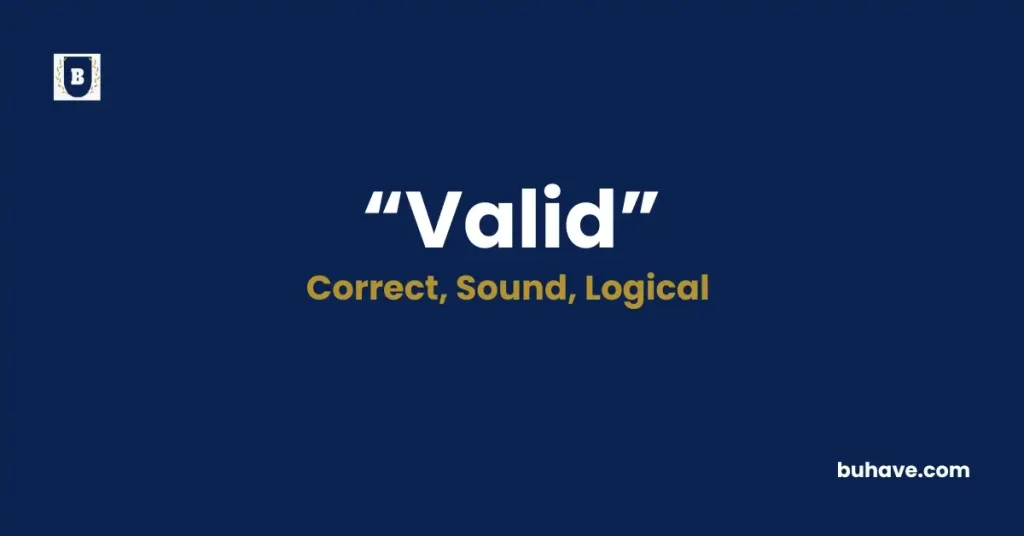
The word ‘Valid’ (adjective) describes something that is legally or logically sound—well-founded, acceptable, and meeting the required standard. In this guide, you’ll learn the full definition, synonyms, antonyms, etymology, and real-life examples of how to use ‘Valid’ correctly in sentences.
Valid Explained in Depth
A complete and detailed guide to the word Valid, including meaning, definition, examples, etymology, synonyms, and antonyms—plus practical ways to recognize what counts as valid in everyday writing, school, and legal contexts.
Meanings of Valid
Valid means having a sound basis in logic or fact, being reasonable, or meeting the requirements of the law or a particular system. It’s often used to describe arguments, documents, or points that are acceptable and recognized as true or correct. In writing and reasoning, valid reasoning focuses on whether the logic holds up—so it matters whether the structure of the argument supports the conclusion.
Definition
Valid is legally binding, well-founded, or logically correct. It often describes something that meets necessary requirements, making it effective and enforceable in a given context. In everyday terms, a valid claim or reason is one you can justify with evidence or standards, even if someone disagrees emotionally.
Etymology
- Derived from the Latin validus, meaning “strong, powerful,” which itself comes from valere, meaning “to be strong” or “to be worth.”
- Entered English in the early 16th century, first appearing with legal and logical connotations.
- Over time, the word broadened from legal use to general reasoning and everyday judgments (for example, “a valid point”).
Example Sentences
- The contract is valid only if both parties have signed it.
- Her argument is valid and supported by solid evidence.
- Is this parking permit still valid, or has it expired?
- The lab results are valid because the sample was handled under controlled conditions.
- We need a valid reason to change the schedule at such short notice.
Valid Synonyms
- Legitimate
- Sound
- Reasonable
- Authentic
- Cogent
- Logical
- Well-founded
- Lawful
- Acceptable
- Tenable
Valid Antonyms
- Invalid
- Unsound
- Illegitimate
- Unfounded
- Questionable
- Baseless
- Unacceptable
- Disputable
- Weak
- False
FAQs about Valid
Here are some frequently asked questions (FAQs) about the word “Valid”.
1. What does “valid” mean in a legal sense?
In legal terms, “valid” means a document or action is enforceable and meets all necessary legal requirements, making it effective in court or under the law.
2. Can “valid” be used in everyday conversation?
Yes. It’s commonly used in daily speech to mean reasonable, logical, or acceptable. For example, “That’s a valid point.”
3. What’s the difference between “valid” and “true”?
“Valid” often implies logical soundness or legal correctness, while “true” means factually correct. Something can be valid in logic (formally correct reasoning) even if one premise is disputed.
4. Does “valid” only apply to documents?
No, it can also refer to arguments, points of view, explanations, and any claim that can be considered sound or acceptable. If you’re assessing the reasoning itself, you may also want to review logic meaning definition synonyms and antonyms.
5. Is “valid” the opposite of “invalid”?
Yes. “invalid” is the direct opposite, meaning not legally binding, not sound, or not acceptable.
Explore more V words
- Positive words that start with V
- Negative words that start with V
- Adjectives that start with V
- Nouns that start with V
- Verbs that start with V
If you’re comparing words with overlapping meanings, it can help to distinguish what is valid reasoning versus what is merely approved meaning in a specific process. And if you’re evaluating credibility, Verified can be a useful related term.