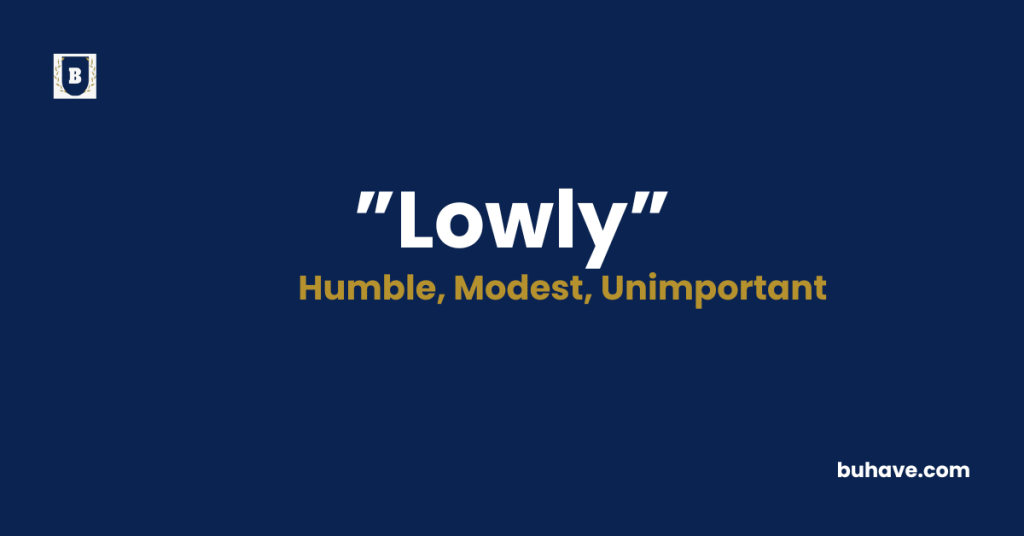
The word “lowly” (adjective) describes someone or something with humble, modest, or lower status, either in rank, condition, or importance. In this guide, you’ll learn the full definition, synonyms, antonyms, etymology, and real-life examples of how to use lowly correctly in sentences.
Lowly Explained in Depth
A complete and detailed guide to the word Lowly including meaning, definition, examples, etymology, synonyms, and antonyms.
Meanings of Lowly
Lowly means humble in rank, position, or condition. It can refer to someone who doesn’t seek attention or status, or to a job, place, or situation in a hierarchy that is considered modest, insignificant, or lower on the social ladder.
Definition
Lowly refers to being humble, unimportant, or lacking high status or position. It may describe people, roles, or even attitudes marked by modesty or lack of pride. Depending on context, lowly can sound neutral (describing rank) or positive (emphasizing humility and simplicity).
Etymology
The word lowly comes from the Old English word hlæw (often linked to meanings related to low ground or burial mounds), connected to ideas of being “low” or “humble.” It combines “low” with the suffix “-ly,” forming an adjective that came to describe a person’s manner or station. The term has been used in English since the Middle Ages to convey humility or a modest social position.
Example Sentences
- In the interview, she thanked her team for starting with a lowly budget and building from there.
- The monk lived a lowly life of service and meditation.
- He began in a lowly position at the factory and later earned a promotion into management.
- Even the lowly potato can become a gourmet dish when roasted with the right spices.
Lowly Synonyms
Lowly Antonyms
- High-ranking
- Important
- Prominent
- Arrogant
- Superior
- Proud
- Prestigious
- Distinguished
- Respected
- Authoritative
FAQs about Lowly
Here are some frequently asked questions (FAQs) about the word “Lowly”
1. What does “lowly” mean?
It refers to being humble in rank, condition, or attitude—often considered less important or socially lower.
2. Can “lowly” describe a person?
Yes. It can describe someone who is modest, humble, or occupying a lower status or role.
3. Is “lowly” always negative?
No. While it can suggest a lack of importance, it can also be used respectfully to highlight humility, service, or simplicity.
4. What are common contexts for using “lowly”?
You’ll often see it in writing about careers (entry-level roles), social status (lower rank), or values (a humble attitude). For a closely related idea, you may also see words like inferiority, though inferiority focuses more on feeling or position compared to others.