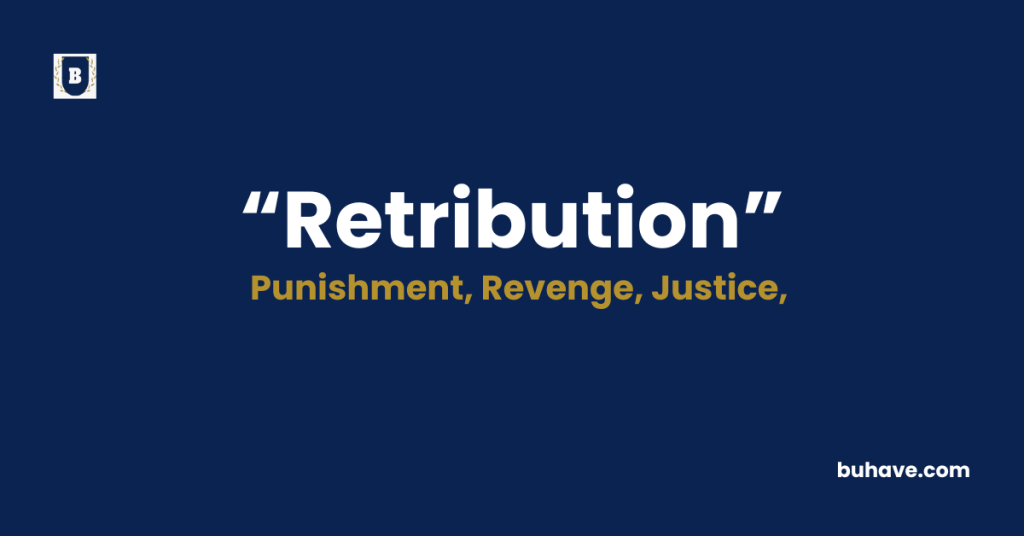
The word ‘Retribution’ (noun) refers to punishment or a penalty that is considered deserved, often viewed as a way of restoring moral balance after a wrong. In this guide, you’ll uncover the full meaning, usage, etymology, and examples of the word ‘Retribution’.
Retribution Explained in Depth
A complete and detailed guide to the word ‘Retribution’ including meaning, definition, examples, etymology, synonyms, and antonyms, with clear ways to use the word in everyday and formal writing.
Meanings of Retribution
‘Retribution’ means deserved punishment or a consequence imposed in response to a wrong action, often framed as moral or ethical justice.
Definition
‘Retribution’ is defined as punishment that is imposed on someone for a wrong or criminal act, typically intended to balance consequences with harm.
Etymology
The word “Retribution” comes from the Latin term retributio, meaning “recompense” or “repayment.” It is built from re- (back) plus tribuere (to allot or assign), originally suggesting giving something back in return—often in the form of justice or penalty. The term entered English in the late 14th to early 15th century, later becoming common in legal and moral discussions.
Example Sentences
- The villagers sought retribution for the harm done to their community.
- In the courtroom, the prosecution argued that retribution was appropriate given the severity of the offense.
- He feared divine retribution for the crimes he believed he had committed.
- The judge delivered a sentence many described as fair retribution for the wrongdoing.
Retribution Synonyms
- Vengeance
- Justice
- Punishment
- Penalty
- Revenge
- Recompense
- Retaliation
- Redress
- Resentment
- Payback
Retribution Antonyms
- Forgiveness
- Mercy
- Pardon
- Clemency
- Compassion
- Absolution
- Leniency
- Amnesty
- Reprieve
- Indulgence
FAQs about Retribution
Here are some frequently asked questions (FAQs) about the word “Retribution.”
1. Is retribution a legal term?
Yes. In legal contexts, retribution is one of the commonly discussed goals of punishment, focusing on holding offenders accountable in proportion to wrongdoing.
2. Can retribution be positive?
It depends on perspective. While retribution involves punishment, some people see it as necessary for justice, deterrence, and closure for victims.
3. How is retribution different from justice?
Justice is broader and can include fairness, equal treatment, and restorative outcomes. Retribution is more specifically about deserved consequences and punishment.
4. What is the difference between retribution and vengeance?
Vengeance often emphasizes personal anger or retaliation, while retribution is typically framed as an objective, morally justified consequence.
Explore more R words
- Positive words that start with R
- Negative words that start with R
- Nouns that start with R
- Verbs that start with R
- Adjectives that start with R
Using Retribution in Writing
When you use the word Retribution, you’re usually signaling that the consequence is deserved and that justice should be reflected through punishment. This makes it common in formal contexts such as academic writing, courtroom discussions, and moral or ethical arguments. If you’re emphasizing fairness and accountability, you can pair retribution with related ideas like punishment and .
To avoid confusion, consider the tone of your sentence. For example, “retribution” can sound principled, while “vengeance” may sound more emotional or personal.
Writers sometimes contrast retribution with alternatives such as redeem (when focusing on making amends) or with softer responses like forgiveness and mercy. If your passage discusses behavior that deserves strong criticism, you may also find words like reprehensible useful for describing the wrong itself.
Finally, be careful with context: retribution is about consequence, not disagreement. If your text is about disagreement with authority, a word like rebellion may be more accurate than retribution.
Common Word Pairings
| Context | Common phrasing | What it implies |
|---|---|---|
| Legal or ethical argument | “Retribution for the offense” | The punishment is deserved and proportionate |
| Victim-focused narrative | “A call for retribution” | Restoring moral balance after harm |
| Religious framing | “Fear of divine retribution” | Consequences tied to moral law |
Key Takeaway
In short, Retribution describes deserved punishment as a response to wrongdoing. It emphasizes accountability and moral balance, which is why it appears in both formal discussions of punishment and everyday explanations of why consequences are expected. If you’re comparing it to other emotions and actions, consider whether your sentence is about principled consequence (retribution) or personal anger and payback (often linked to resentment and vengeance).