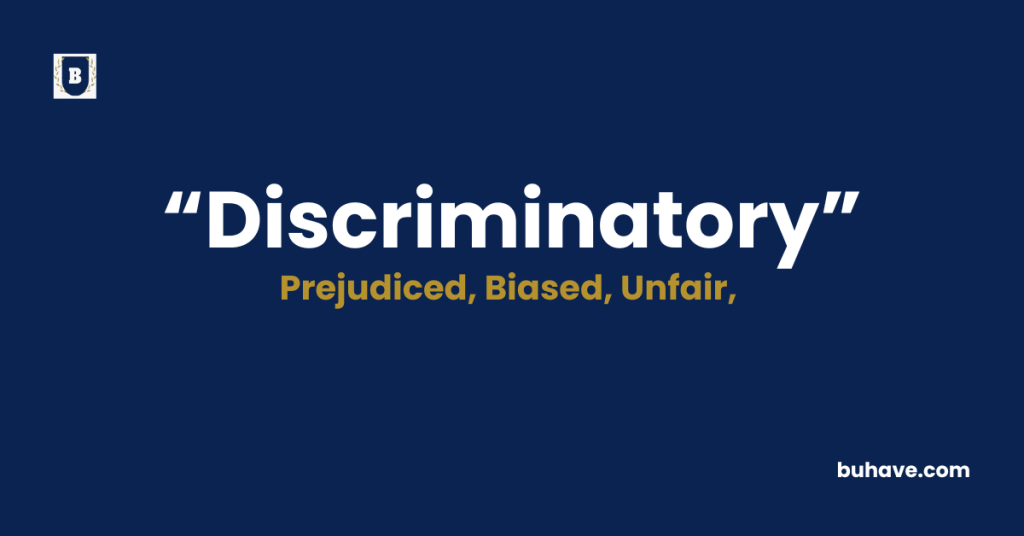
The word Discriminatory (adjective) refers to actions, policies, or attitudes that unfairly differentiate or exclude people based on traits like race, gender, age, religion, or disability. In this guide, you’ll learn the full definition, synonyms, antonyms, etymology, and real-life examples of how to use Discriminatory correctly in sentences.
Discriminatory Explained in Depth
A complete and detailed guide to the word Discriminatory including meaning, definition, examples, etymology, synonyms, and antonyms.
Meanings of Discriminatory
Discriminatory means treating someone differently, often unjustly, based on characteristics such as race, gender, age, religion, or disability. It involves biased or unfair distinctions that limit equal opportunity or access.
Definition
Discriminatory refers to behavior, language, policies, or decisions that create inequality by distinguishing people for unjust or prejudiced reasons. This includes unequal treatment in employment, housing, education, healthcare, or social interactions. The term is often used for both individual actions and systemic practices (for example, patterns in hiring, benefits, or enforcement) that reinforce marginalization, exclusion, or stereotypes.
Importantly, not all distinctions are discriminatory. The key idea is the effect: discriminatory actions are those that produce harm, unfair treatment, or disadvantage. These can be direct (for example, refusing service based on ethnicity) or indirect (for example, using a requirement that seems neutral but predictably excludes a protected group).
The word is commonly used in legal, educational, and workplace settings to identify and address inequality. Societies aiming for fairness try to recognize and eliminate discriminatory practices to support inclusion and respect for human dignity.
If you’re also learning related vocabulary, see Prejudiced meaning definition synonyms and antonyms to understand how bias often appears before policies become discriminatory.
Etymology
The word “discriminatory” is derived from the Latin verb discriminare, meaning “to divide or separate.” It combines dis- (apart) and crimen (judgment or accusation). The root idea was to distinguish or judge between things. In English, discriminate originally meant to make distinctions, which could be neutral or even positive.
Over time—especially from the 19th century onward—the meaning shifted toward unjust or biased distinctions in social, political, and legal contexts. As a result, discriminatory came to strongly convey negative implications of inequality, particularly in civil rights discussions and diversity initiatives worldwide.
In modern usage, the term often shows up alongside words like Disability meaning definition synonyms and antonyms, because disability-related discrimination is a major area of concern in workplaces and public services.
Example Sentences
- The company faced legal action after evidence showed discriminatory hiring practices.
- Discriminatory laws and enforcement can block equal access to education and healthcare.
- In customer service, discriminatory comments can lead to complaints, investigations, and training.
- It’s important to recognize and challenge discriminatory behavior in daily life, even when it’s subtle.
Discriminatory Synonyms
- Prejudiced
- Disrespectful
- Biased
- Unjust
- Inequitable
- Exclusionary
- Unfair
- Unequal
- Stereotypical
- Segregative
Discriminatory Antonyms
- Impartial
- Fair
- Equal
- Just
- Inclusive
- Disciplined
- Unbiased
- Equitable
- Neutral
- Open-minded
FAQs about Discriminatory
Here’s a FAQ-style guide about the word “Discriminatory”
1. What does discriminatory mean?
Discriminatory means unfair treatment of individuals or groups based on attributes like race, gender, age, religion, or disability.
2. Is all discrimination considered discriminatory?
No. People often use the terms in different ways, but in everyday discussion, only discrimination that leads to unfair or harmful treatment is considered discriminatory.
3. Where does discriminatory behavior occur?
It can appear in workplaces, schools, housing, public services, healthcare settings, and everyday interactions such as hiring, scheduling, or customer service.
4. How can discriminatory policies be challenged?
People can challenge discriminatory policies through education, public advocacy, documentation, and legal action where appropriate.
5. Can discriminatory actions be unintentional?
Yes. Some policies may seem neutral but still produce discriminatory effects. This is why impact and outcomes often matter as much as intent.