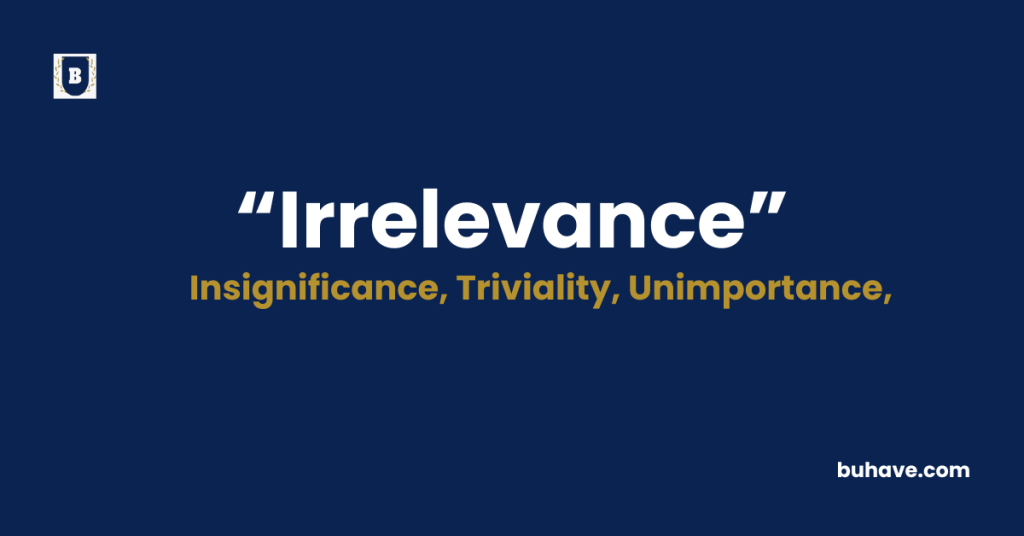
The word ‘Irrelevance’ is a noun that describes the quality or state of being unrelated, unimportant, or not connected to the matter at hand. In this guide, you’ll learn the full definition, synonyms, antonyms, etymology, and real-life examples of how to use ‘Irrelevance’ correctly in sentences.
Irrelevance Explained in Depth
A complete and detailed guide to the word Irrelevance including meaning, definition, examples, etymology, synonyms, and antonyms, plus practical ways to spot and avoid irrelevant points in writing and discussion.
Meanings of Irrelevance
‘Irrelevance’ describes something that lacks significance, importance, or a direct connection to a particular topic, issue, or situation. It implies that the subject or action has no bearing on the point being discussed, which is why it often appears in arguments, meetings, and legal contexts.
Definition
Irrelevance is the state or condition of being not pertinent, applicable, or significant in a given context. It highlights the disconnect between an idea, statement, or action and the main issue or topic.
Etymology
The word ‘irrelevance’ comes from the prefix ir- (meaning “not”) combined with relevant, ultimately from Latin relevare (meaning “to raise or lift”), plus the noun-forming suffix -ence. The term entered English as a way to name the lack of meaningful connection to a given matter.
Example Sentences
- His comments were dismissed due to their irrelevance to the topic.
- The judge struck out the evidence for its irrelevance to the case.
- She realized the irrelevance of past arguments in the present situation.
- Many trends fade into irrelevance over time.
- The speaker’s off-topic stories added a sense of irrelevance to the discussion.
- In the email thread, the proposal section matters; the background history became irrelevant fast.
Irrelevance Synonyms
- Insignificance
- Immateriality
- Unimportance
- Disconnection
- Inapplicability
- Pointlessness
- Unrelatedness
- Frivolity
- Detachment
- Ineffectiveness
Irrelevance Antonyms
- Relevance
- Importance
- Significance
- Connection
- Applicability
- Pertinence
- Meaningfulness
- Relatedness
- Value
- Influence
FAQs about Irrelevance
Here are some frequently asked questions (FAQs) about the word “Irrelevance”.
1. Is irrelevance always negative?
Not necessarily. In some contexts, irrelevance can help maintain focus by identifying what doesn’t matter for the goal or decision.
2. How is irrelevance used in debates or discussions?
Irrelevance is often pointed out to refocus a discussion and eliminate distractions or unrelated points that don’t support the main claim.
3. Can a person feel a sense of irrelevance?
Yes. People may experience feelings of irrelevance when they believe they lack purpose, visibility, or impact in a situation.
4. What’s the difference between irrelevance and insignificance?
Irrelevance means something is not connected to the topic; insignificance means something lacks importance, even if it’s related.
5. How can we avoid irrelevance in writing?
Stay focused on the topic, make sure each paragraph supports your thesis, and remove details that don’t advance your argument. If you’re unsure, ask whether the line would still make sense if the main topic were removed.
Explore more I words
- Positive words that start with I
- Negative words that start with I
- Adjectives that start with I
- Verbs that start with I
- Nouns that start with I
- Indifferent (often confused in casual writing when people actually mean “not connected” rather than “not interested”)