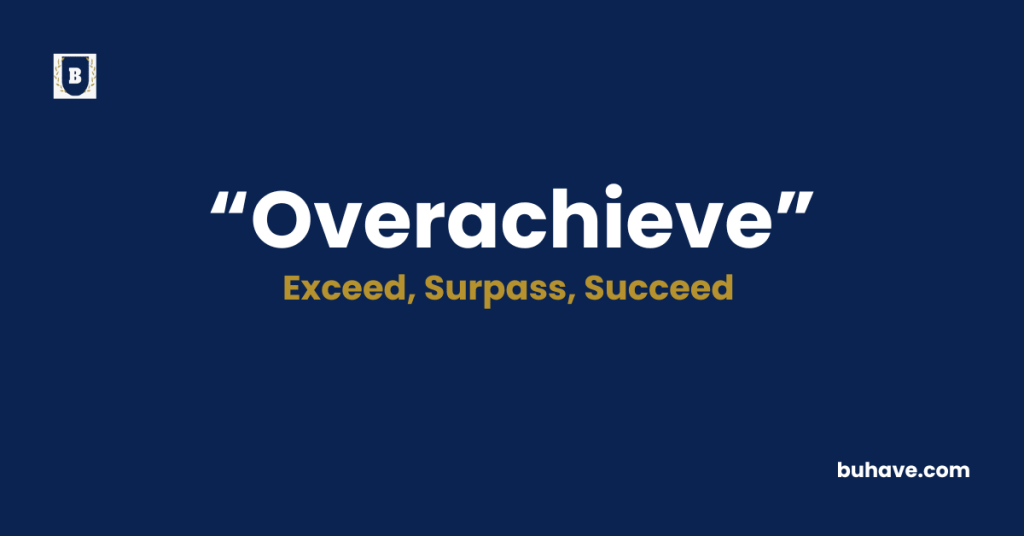
The word ‘Overachieve’ (verb) describes the act of performing better or achieving more than expected, often by exceeding normal standards or even one’s own limits. In this guide, you’ll learn the full definition, synonyms, antonyms, etymology, and real-life examples so you can use ‘overachieve’ accurately in your writing and everyday speech.
Overachieve Explained in Depth
A complete and practical guide to the word overachieve, covering meaning, definition, examples, etymology, synonyms, and antonyms. You’ll also find answers to common questions about how and when to use the verb naturally.
Meanings of Overachieve
The verb “overachieve” means to exceed expectations or accomplish more than what is typically considered possible or realistic. It’s commonly used for people who go beyond the norm in academics, work, sports, or personal goals. Overachievers may surpass goals set by others and, just as often, their own internal standards. The word is usually associated with ambition and persistence, but it can also carry a cautionary tone, suggesting extra pressure, unrealistic expectations, or a risk of burnout.
In educational and professional settings, someone who overachieves might consistently outperform peers, deliver standout results, or take on responsibilities beyond what the role requires. That drive can be celebrated, yet it may also create stress through a constant push for perfection. Overachievement is frequently fueled by internal motivation (such as a desire to prove oneself) and/or external pressure (such as expectations from family, supervisors, or society).
Whether it’s an athlete reaching an unexpected level of performance or a student maintaining strong grades while managing extracurriculars, overachieving reflects determination, discipline, and a drive to excel beyond the expected baseline.
Definition
Overachieve is a verb that means to perform better or achieve more than expected, especially in academics, work, or personal performance. It involves going past a standard level of success through exceptional effort, talent, or determination.
When someone overachieves, they often surprise others with outcomes that are higher than anticipated. This could look like a student from a disadvantaged background who excels academically, an employee who advances quickly due to consistent performance, or someone who learns a new skill faster than expected. Overachieving isn’t limited to “natural talent”; it often comes from structured effort, consistent practice, and a strong mindset. People who overachieve tend to set high personal targets and may feel uneasy about settling for the minimum. While this mindset can lead to impressive results, it may also contribute to anxiety, perfectionism, or an imbalance between work and rest if not managed carefully.
Etymology
The etymology of “overachieve” combines the prefix over- with the verb achieve. Here’s how the parts contribute to the meaning:
- Prefix: “over-” – Historically linked to Old English ofer, meaning “above, beyond, or excessively.” In modern English, it suggests doing something to a greater-than-normal degree.
- Root: “achieve” – Traces back to Old French achever, meaning “to bring to a head” or “to accomplish,” and further to Latin ad caput, meaning “to bring to a head or end.”
“Overachieve” entered common English usage in the mid-to-late 20th century, especially in discussions of education and performance. It was used to describe students who performed above what certain tests predicted, often influenced by effort and discipline. Over time, the meaning expanded to include people who outperform expectations across a wide range of areas, including business, sports, and everyday life. Even though it highlights exceptional success, the “over-” prefix can also imply that the result is unusually high, surprising, or possibly excessive, adding complexity to the tone.
Example Sentences
- Despite facing many challenges, she continued to overachieve throughout her academic career.
- He tends to overachieve on every project, often exceeding what the team expects.
- Some children overachieve due to pressure, while others are naturally driven by curiosity.
- The startup overachieved in its first year, surpassing its sales projections.
- While it’s good to aim high, constantly trying to overachieve can lead to burnout.
Overachieve Synonyms
Overachieve Antonyms
- Underachieve
- Fall short
- Underperform
- Lag behind
- Fail
- Miss the mark
- Disappoint
- Come up short
- Slack off
- Stumble
FAQs about Overachieve
Here are some frequently asked questions (FAQs) about the verb “overachieve,” including how it’s used and what it can imply in different situations.
1. What does “overachieve” mean in simple terms?
It means to do better than expected, usually by working very hard or being exceptionally skilled.
2. Is overachieving always a good thing?
Not always. Overachieving often shows ambition and drive, but it can also lead to stress or burnout if the effort isn’t balanced with rest and realistic goals.
3. Can anyone become an overachiever?
In many cases, yes. With motivation, consistent effort, and good habits, most people can overachieve in at least one area of their life.
4. What causes someone to overachieve?
It can come from personal ambition, a desire to prove oneself, strong interest in a subject, or external pressure from others.
5. Is overachieving the same as being successful?
Overachieving is one type of success because it exceeds expectations, but success can also mean reaching realistic, well-balanced goals. In other words, you can be successful without necessarily overachieving.
6. Can overachieving be harmful?
Yes, if taken to extremes. Overachievers may neglect rest, relationships, or self-care while chasing excellence, which can negatively affect long-term well-being.
7. What’s the difference between high achievers and overachievers?
High achievers consistently meet demanding goals, while overachievers go a step further by exceeding what’s expected, sometimes even going beyond the high goals themselves.
Explore more O words
Positive words that start with O
Negative words that start with O
Adjectives words that start with O
Nouns that start with O
Verbs that start with O