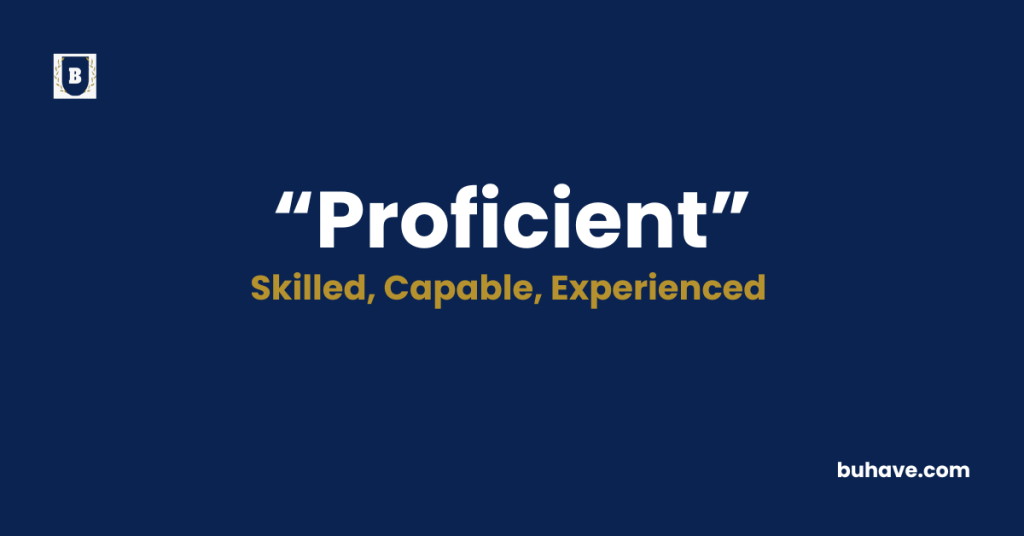
The word ‘Proficient’ (adjective) describes someone who is skilled, competent, or well-versed in a particular activity, subject, or task. In this guide, you’ll learn the full definition, synonyms, antonyms, etymology, and real-life examples of how to use ‘proficient’ correctly in sentences.
Proficient Explained in Depth
A complete and practical guide to the word Proficient, including meaning, definition, etymology, examples, synonyms, and antonyms. In everyday conversation, it often describes someone who can reliably do something without constant help.
Meanings of Proficient
The word proficient is used to describe a person who has a high level of skill or competence in a particular area, field, or subject. Being proficient means more than being familiar with something; it means you can perform it efficiently and effectively, often with a level of mastery that goes beyond basic understanding.
Proficient is frequently used in educational, professional, and technical contexts to describe capability and expertise—for example, being proficient in a language, computer programming, writing, data analysis, or a specific job role.
Proficiency also suggests that the skill is repeatable. In other words, a proficient person can apply what they know to real situations, solve problems, and produce consistently strong results. A proficient musician doesn’t just read notes; they interpret and perform with fluency. A proficient speaker of a foreign language can communicate comfortably and handle more complex grammar and vocabulary.
Finally, the term can imply ongoing improvement. People who are proficient usually keep sharpening their abilities through practice, feedback, and experience.
Definition
Proficient is defined as being competent or skilled in doing or using something. It points to a strong command of an ability—often developed through learning, practice, and experience—so the person can apply that knowledge effectively in real-world situations.
In academic and professional settings, being proficient often suggests a certain level of independence and confidence in performance. For example, a student who is proficient in mathematics understands core concepts and can apply them to new problems without getting stuck right away.
Because proficiency reflects reliability and a high standard of performance, it helps distinguish someone who is still learning from someone who can produce meaningful, consistent results through skill.
Etymology
The etymology of the word proficient traces back to Latin and highlights its long-standing connection to progress and practical expertise. It developed through multiple stages before becoming the modern English word:
- Latin: The root word is proficere, meaning “to progress,” “to advance,” or “to be useful.” It is formed from pro- (meaning “forward”) and facere (meaning “to do” or “to make”). Together, proficere can be understood as “to make progress” or “to move forward in doing.”
- Late Latin: proficientem (present participle) carried meanings related to “advancing” or “making progress.”
- Middle French: The term entered Middle French as proficient, meaning “capable” or “adept.”
- Middle English: It entered English in the 15th century with meanings tied to advanced knowledge or skills in a particular area.
This history reinforces the core idea that proficiency reflects advancement through effort. The Latin facere (“to do”) also points to action, not just understanding, emphasizing that proficient people can execute skills effectively. Today, the word still carries that same sense of applied knowledge and measurable progress.
Example Sentences
- She is highly proficient in three languages and can switch between them with ease.
- The technician was proficient in diagnosing problems and repairing complex machinery without constant supervision.
- Becoming proficient in coding takes time, patience, and consistent practice.
- Her proficient writing style earned her a role in a top publishing firm.
- The athlete became proficient in multiple sports before deciding to specialize in tennis.
- After a few months of training, he became proficient with the new software at work.
Proficient Synonyms
- Skilled
- Competent
- Adept
- Capable
- Experienced
- Expert
- Efficient
- Well-versed
- Qualified
- Trained
Proficient Antonyms
- Inept
- Incompetent
- Unskilled
- Inexperienced
- Unqualified
- Clumsy
- Amateurish
- Ignorant
- Novice
- Incapable
FAQs about Proficient
Here are some frequently asked questions (FAQs) about the word “Proficient,” answered in clear, practical terms.
1. What does “proficient” mean in simple terms?
“Proficient” means being good at something because you have the skill, training, or experience needed to do it well.
2. How can someone become proficient?
Through consistent learning, regular practice, real-world experience, and feedback that helps you improve specific weaknesses.
3. Is “proficient” a formal word?
Yes, it’s commonly used in professional and academic contexts, especially in résumés, evaluations, and job descriptions. It can also be used in everyday conversation, though “good at” may feel more casual.
4. Can you use “proficient” in a resume?
Absolutely. It’s especially useful for listing technical skills, language abilities, and job-related competencies when you want to signal reliable competence.
Explore more p words
Positive words that start with P
Negative words that start with P
Names that start with P
Nouns that start with P