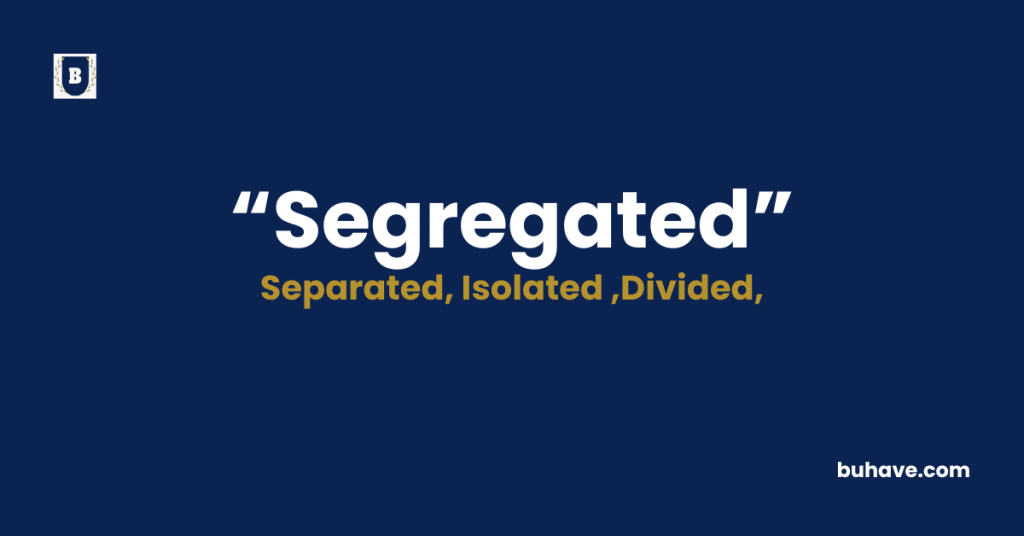
The word Segregated (adjective) means kept apart or separated from others, often because of race, class, religion, gender, or another distinguishing trait. In this guide, you’ll learn the full definition, synonyms, antonyms, etymology, and real-life examples of how to use Segregated correctly in sentences.
Segregated Explained in Depth
Learn what “segregated” means, where it comes from, how it’s used in everyday and academic contexts, and how it differs from similar words like isolation and division.
Meanings of Segregated
Segregated means kept apart or separated from others, especially based on race, class, religion, gender, or another distinguishing trait. It often implies enforced or systemic separation, rather than just simple preference.
Definition
Segregated describes a state or condition in which individuals or groups are isolated from one another due to imposed or maintained differences. This separation may be social, physical, legal, or institutional. Commonly, the term is associated with racial segregation, such as the historical policies that separated Black and white people in schools, housing, and public spaces. However, it can also refer to gender-segregated facilities, religious divisions, or economic class separations. In modern use, the word carries strong implications of inequality, exclusion, or injustice.
For example, a segregated school system may limit equal access to resources and opportunity. While segregation can be intentional or unintentional, it often leads to systemic disadvantages, shaping outcomes over time. Today, many democratic societies reject segregation and instead promote integration, inclusion, and equity in education, housing, and public life.
Etymology
The word “segregated” stems from the Latin verb segregare, meaning “to separate from the flock.” It combines se- (apart) and grex (herd or group). This Latin origin emphasized the act of setting apart. The word entered English in the early 17th century, initially describing the separation of groups or categories. Over time—especially in the 19th and 20th centuries—it became closely tied to legal and social systems that separated people based on race.
Segregation laws were particularly evident in the United States during the Jim Crow era and in South Africa during apartheid. These policies institutionalized inequality and discrimination. Today, while the term can describe any type of enforced separation, it is widely recognized as a symbol of past injustice and a reminder of the importance of social inclusion.
Example Sentences
- The school district worked to end segregated schooling after court orders required integration.
- Some neighborhoods can become segregated over time due to housing costs and policy decisions.
- A segregated workplace structure may reduce collaboration between teams and limit professional growth.
- In some historical accounts, public transportation is described as segregated by law.
Segregated Synonyms
Segregated Antonyms
- Integrated
- Unified
- Inclusive
- Mixed
- Combined
- Together
- Blended
- Harmonized
- Connected
- Intertwined
FAQs about Segregated
Here’s a FAQ-style guide about the word “Segregated.”
1. What does segregated mean?
It means kept apart or separated from others, especially based on group identity like race, religion, or class.
2. Is segregation always negative?
In most contexts, yes. Even when “separation” is described as neutral, segregation usually implies inequality or exclusion and is viewed negatively.
3. Can modern societies still be segregated?
Yes. Social and economic patterns can create informal or systemic segregation, even where laws prohibit it.
4. What’s the difference between segregated and separated?
“Separated” can be neutral, while “segregated” often suggests inequality, discrimination, or legal/systemic enforcement.
5. Does segregation relate to discrimination?
Often, yes. Segregation can be part of discriminatory systems that treat groups unfairly or restrict access to opportunities.