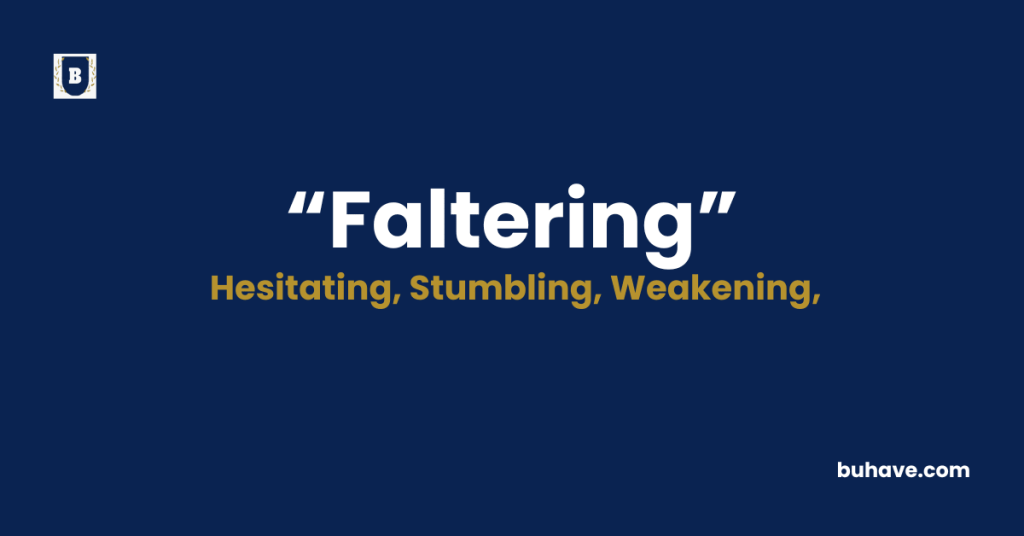
The word ‘Faltering’ (adjective) means losing strength, confidence, or momentum. It often describes hesitation, uncertainty, or a temporary slowdown in progress, whether in speech, action, or performance. In this guide, you’ll get a full understanding of the term, including its meaning, usage, origins, and more.
Faltering Explained in Depth
A complete and detailed guide to the word ‘Faltering’ including meaning, definition, examples, etymology, synonyms, and antonyms. If you’re also learning nearby vocabulary, you may find it helpful to compare Falter meaning with this adjective form.
Meanings of Faltering
Faltering describes a lack of certainty or firmness. It can refer to a person’s shaky voice, uncertain steps, or dwindling confidence in the face of challenges.
Definition
Faltering means becoming weak, unsteady, or hesitant; losing confidence or effectiveness. It can also describe progress that continues but slows down or becomes difficult.
It can refer to a person’s shaky voice, uncertain steps, or dwindling confidence in the face of challenges.
Etymology
The word ‘faltering’ comes from the Middle English verb falteren, meaning “to stagger or stumble.” The exact origin is not fully certain, but the form appears to reflect the sound or feeling of struggling to keep steady.
Example Sentences
- His faltering voice revealed how nervous he felt.
- After the initial success, their business took a faltering turn.
- She took a few faltering steps before stopping from exhaustion.
- The negotiations continued in a faltering manner, with no clear resolution.
Faltering Synonyms
Faltering Antonyms
FAQs about Faltering
Here are some frequently asked questions (FAQs) about the word “Faltering.”
1. Is faltering always a negative term?
Not always. It can indicate a temporary lapse in strength or confidence, and it can also reflect caution or human vulnerability.
2. Can faltering describe speech?
Yes. A faltering voice often suggests nervousness, strong emotion, uncertainty, or difficulty concentrating.
3. Is faltering used in business or technical contexts?
Yes. It can describe weakening performance, unstable progress, or a downward shift in results over time.
4. What part of speech is “faltering”?
It can be an adjective (for example, “a faltering plan”) or the present participle of the verb “to falter.”
5. How does faltering differ from failing?
Faltering suggests a temporary or partial loss of strength or certainty, while failing implies a complete breakdown or lack of success.
Faltering vs. Similar Words
If you’re choosing wording for writing or speaking, it helps to distinguish faltering from closely related terms:
| Word | What it suggests | Common context |
|---|---|---|
| Faltering | A shaky, unsteady moment or slowdown in progress | Speech, decisions, leadership, negotiations |
| Failing | Ongoing lack of success or a shortcoming | Goals, systems, performance outcomes |
| Declining | A gradual decrease over time | Health, quality, trends, numbers |
| Fading | A gradual loss of visibility, strength, or prominence | Light, sound, emotions, memory |
For more vocabulary in the same area, you can also review Failing meaning, Declining meaning, and Fading meaning.