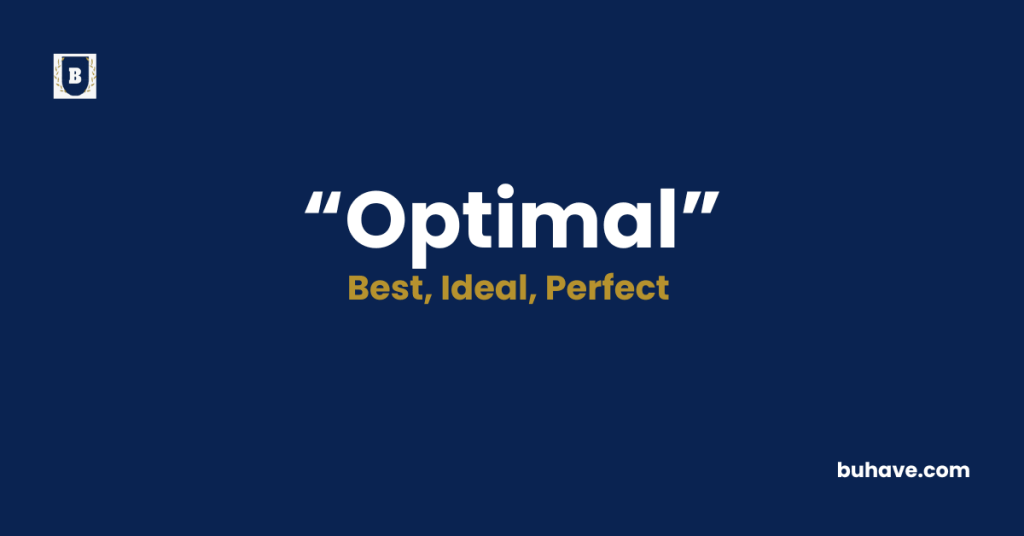
The word ‘Optimal’ (adjective) describes the best or most favorable option for a specific situation. In this guide, you’ll learn the full definition, synonyms, antonyms, etymology, and real-life examples of how to use ‘Optimal’ correctly in sentences.
Optimal Explained in Depth
A clear, practical guide to the word optimal, including meaning, definition, examples, etymology, synonyms, and antonyms.
Meanings of Optimal
The word optimal refers to the most desirable or effective condition, degree, or amount for a particular situation. It’s used when something isn’t just “good,” but the best choice given the available constraints and options. In other words, “optimal” points to a result that has been tuned to reach the strongest balance of performance, efficiency, or overall outcome.
Whether in science, business, health, engineering, or everyday decisions, “optimal” helps you describe the highest level of suitability for a specific context rather than a universal “best.”
For instance, when adjusting the temperature for baking bread, the optimal heat is the one where the dough rises well and develops the right crust and texture. In business, an optimal strategy is the one that delivers maximum results with the least waste of time, money, or materials. You’ll also see “optimal” in wellness contexts—like “optimal nutrition” or “optimal sleep”—to describe conditions that support the best possible health and performance. In short, using “optimal” means aiming for the best approach or amount for the circumstances, not claiming perfection in every scenario.
Definition
Optimal is the most favorable, desirable, or effective condition or outcome under specific constraints. It denotes the best possible solution or choice in a scenario, typically reached through careful evaluation, testing, modeling, or analysis.
The term is widely used in mathematics, engineering, medicine, economics, and technology to describe systems operating at or near their highest potential. For example, in computing, an optimal algorithm completes a task as quickly as possible while using the fewest practical resources (like memory). In health, achieving optimal hydration means maintaining the right balance of fluids to support normal bodily functions.
What distinguishes “optimal” from words like “great” or “excellent” is that it is context-sensitive: it means best for a particular situation. The goal of optimal conditions is to maximize performance, efficiency, or well-being while reducing negative trade-offs.
Etymology
The etymology of the word “optimal” traces back to Latin roots and reflects the idea of “choosing the best” for a given set of circumstances:
- Root: “optimus” – In Latin, “optimus” means “best” or “very good.” It is a superlative form connected to “bonus” (good), used to describe something of the highest quality.
- Modern derivation: “optimalis” – In Late Latin, “optimalis” came to mean “related to the best” or “pertaining to the best conditions.”
The English word “optimal” began appearing in the early 19th century, especially in scientific and academic writing, to describe the most advantageous conditions within a system or model. Over time, the word spread into everyday contexts, including health discussions and business decision-making.
It also connects to related forms such as “optimum” (used as both a noun and adjective in technical writing) and “optimize” (a verb meaning to make something as effective or well-suited as possible). All share the same core idea: maximizing benefit or performance under the relevant conditions.
Example Sentences
- The optimal time to plant tomatoes is after the last frost in spring.
- She adjusted the settings for optimal performance on her laptop during video editing.
- A balanced diet, hydration, and regular exercise are essential for optimal health.
- The design team refined the model for optimal energy efficiency in real-world conditions.
- He planned the optimal route to avoid traffic and reduce his commute time.
- For optimal learning, break study sessions into shorter blocks and include short reviews.
Optimal Synonyms
- Best
- Ideal
- Most efficient
- Perfect
- Prime
- Maximum
- Finest
- Most suitable
- Most favorable
- Tailored
- Appropriate
- Well-chosen
Optimal Antonyms
- Poor
- Ineffective
- Inadequate
- Suboptimal
- Inferior
- Unsuitable
- Deficient
- Flawed
- Imperfect
- Unfavorable
- Inefficient
- Risky
FAQs about Optimal
Here are some frequently asked questions (FAQs) about the word “Optimal.”
1. What does “optimal” mean in simple terms?
It means the best possible or most effective choice in a particular situation, considering the constraints and conditions.
2. Is “optimal” the same as “perfect”?
No. “Perfect” suggests flawlessness in every respect, while “optimal” means the best option for the situation—even if it still has trade-offs.
3. Can you use “optimal” in everyday conversation?
Yes. It’s often slightly more formal than words like “best,” but it’s still used commonly to describe ideal choices, timing, or conditions.
4. What is the noun form of “optimal”?
The noun form is “optimum,” which refers to the best or most favorable condition or result.
5. Is “optimal” always a positive word?
In practice, yes. “Optimal” refers to the most desirable outcome or best conditions in a context, even if achieving it requires effort or trade-offs.
6. Can something be “too optimal”?
Sometimes, yes. Over-optimizing a process can reduce flexibility, create unnecessary complexity, or deliver diminishing returns. The word “suboptimal” is often used when an approach doesn’t work as well in real life as it does in theory.
7. How is “optimal” used in health and fitness?
In health, “optimal” refers to the best conditions for physical or mental well-being, such as good sleep quality, balanced nutrition, stress management, and training that fits your current needs.
8. What’s the difference between “optimal” and “efficient”?
“Efficient” emphasizes using resources wisely (like time or energy). “Optimal” emphasizes achieving the best outcome overall, which may or may not be the same as the most efficient method.
Explore more O words
Positive words that start with O
Negative words that start with O
Adjectives words that start with O