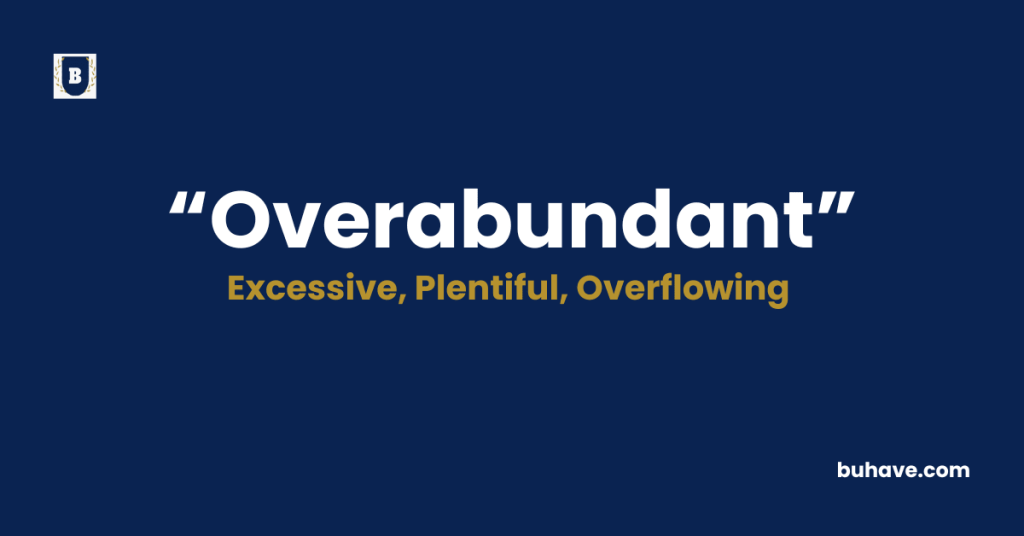
The word ‘Overabundant’ (adjective) means existing in quantities that are far greater than needed, wanted, or useful. In this guide, you’ll learn the full definition, synonyms, antonyms, etymology, and real-life examples of how to use ‘Overabundant’ correctly in sentences.
Overabundant Explained in Depth
A complete and detailed guide to the word Overabundant, including meaning, definition, examples, etymology, synonyms, and antonyms. Use this adjective when something is not just plentiful, but too plentiful for the situation.
Meanings of Overabundant
The word overabundant refers to something that is present in far greater quantities than are needed, wanted, or manageable. It often carries a slightly negative tone, implying that the excess might lead to waste, imbalance, or even discomfort. This word is typically used when discussing natural resources, emotions, data, opportunities, or personality traits that show up too often or too intensely.
For example, if a garden produces far more tomatoes than a family can consume, the harvest might be described as overabundant. Similarly, a person who gives constant advice without being asked could be said to offer overabundant opinions. While abundance is generally seen as a good thing, “overabundant” highlights that too much of something—even something positive—can become a burden, reduce effectiveness, or create confusion. In other words, the term communicates when balance is missing and when too much of a good thing starts to work against you.
Definition
Overabundant is defined as an adjective that means more than sufficient; excessively plentiful; existing in a quantity so large that it becomes more than desirable or useful. It suggests that something goes beyond the level of abundance into the realm of excess.
Unlike the word “abundant,” which implies a generous or ample amount that is usually welcome, “overabundant” takes this one step further—into territory where there may be surplus, waste, inefficiency, or unintended negative effects. It can apply to tangible things like food, water, money, and storage space, as well as intangible elements like attention, praise, hype, or emotions. In environmental discussions, for example, an overabundant population of a species can upset the ecosystem’s balance. In interpersonal communication, overabundant enthusiasm might feel overwhelming. The word is especially helpful when you want to describe the fine line between “enough” and “too much” without sounding vague.
Etymology
The word “overabundant” is formed from two components in English that, when combined, clearly convey the idea of excess:
- Prefix: “over-” – Derived from Old English ofer, meaning “beyond,” “above,” or “excessive.” This prefix is commonly used to express excessiveness or exaggeration, as in words like “overdo,” “overeat,” and “overreact.”
- Root: “abundant” – From Latin abundantem (present participle of abundare), meaning “to overflow” or “to be plentiful.” The sense includes something flowing beyond normal levels.
Put together, “overabundant” literally means “excessively overflowing” or “too plentiful.” The term developed in English by combining the positive notion of “abundance” with the modifying prefix “over-” to signal that the supply has gone beyond what is reasonable or beneficial. This construction follows a common English pattern of forming compound meaning around degree and intensity, similar to how words like “over-” + root can describe variations in level.
Example Sentences
- The overabundant rainfall this season caused widespread flooding across the valley.
- Her overabundant enthusiasm for the project sometimes overwhelmed her more reserved teammates.
- The forest was overabundant with deer, which began to damage local vegetation.
- We received an overabundant supply of materials, far more than the event actually required.
Overabundant Synonyms
- Excessive
- Superfluous
- Overflowing
- Redundant
- Overloaded
- Glutted
- Too much
- Surplus
- Overfull
- Teeming
Overabundant Antonyms
- Scarce
- Insufficient
- Limited
- Lacking
- Inadequate
- Sparse
- Deficient
- Minimal
- Short
- Rare
FAQs about Overabundant
Here are some frequently asked questions (FAQs) about the word “Overabundant”.
1. What does “overabundant” mean in everyday language?
In everyday language, it means there’s too much of something more than is needed, useful, or even healthy in some cases.
2. Is “overabundant” a negative word?
Generally, yes. It suggests that an otherwise good thing has become excessive and possibly problematic.
3. Can you use “overabundant” for emotions?
Yes. You can describe feelings like love, fear, or anxiety as overabundant if they are experienced too intensely or frequently for the situation.
4. How is “overabundant” different from “abundant”?
“Abundant” implies a good amount—plenty but manageable. “Overabundant” implies too much, to the point of being undesirable or unworkable.
5. Does overabundance always have a negative impact?
Not always, but it often leads to inefficiency, waste, confusion, or imbalance, depending on the context.
6. Can “overabundant” apply to digital content or information?
Yes. In the digital age, overabundant data or information can lead to overload, making it harder to focus, decide, or act.
Explore more O words
Positive words that start with O
Negative words that start with O
Names that start with O
Nouns that start with O
Verbs that start with O