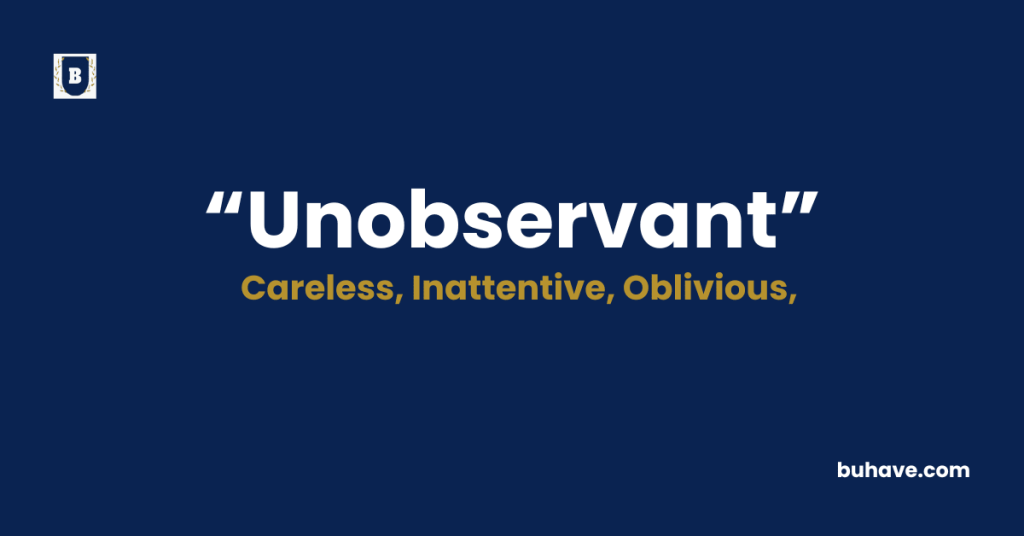
The word Unobservant (Adjective) describes someone who does not notice what is happening around them or who misses important details. In this guide, you’ll learn the full definition, synonyms, antonyms, etymology, and real-life examples of how to use Unobservant correctly in sentences.
Unobservant Explained in Depth
A complete and detailed guide to the word Unobservant including meaning, definition, examples, etymology, synonyms, and antonyms.
Meanings of Unobservant
Unobservant means not noticing what is going on around you or failing to pay close attention to details. It often implies a lack of awareness, mindfulness, or perception, whether of physical surroundings or social cues. For related meaning, see Inattentive meaning.
Definition
Unobservant refers to a person’s tendency to overlook details, miss important signs, or be inattentive to events or changes in their environment. This trait can show up in small ways, like missing a typo, or in more serious contexts, such as failing to notice someone’s emotional distress. Unobservant individuals often struggle with awareness either visual, emotional, or social.
While it doesn’t always imply deliberate neglect, it may reflect a habitual lack of focus, disinterest, or distraction. In contrast to observant people who catch subtle cues and patterns, the unobservant often miss the deeper or more meaningful elements of a situation.
Etymology
The word “unobservant” is formed by the prefix un-, meaning “not,” combined with observant, which comes from the Latin verb observare, meaning “to watch, heed, or notice.” “Observant” entered English in the late 14th century and originally referred to someone who obeyed rules or was watchful. The negative form, “unobservant,” developed later to describe people who lack this attentiveness or perception. Its history reflects how strongly English values careful attention in both everyday interactions and academic settings.
Example Sentences
- He was so unobservant that he didn’t notice the sign right in front of him.
- Her unobservant nature made her miss the subtle hints in the conversation.
- The teacher criticized the student for being unobservant during the science experiment.
- In meetings, he can be unobservant about tone, so he sometimes misunderstands concerns that are clearly stated.
Unobservant Synonyms
- Inattentive
- Oblivious
- Heedless
- Unfocused
- Negligent
- Careless
- Unaware
- Forgetful
- Unmindful
- Unalert
Unobservant Antonyms
FAQs about Unobservant
Here are some frequently asked questions (FAQs) about the word “Unobservant.”
1. What does “unobservant” mean?
It means lacking attention to detail, being unaware of surroundings, or not noticing important cues or events.
2. Is being unobservant a personality trait?
It can be. Some people naturally pay less attention to detail or may be distracted more easily, but it can also be improved with practice and better routines.
3. Can unobservant people become more observant?
Yes. With mindfulness training, practice, and intentional focus, people can improve their observational skills over time.
4. What are some signs of being unobservant?
Missing obvious cues, forgetting details, failing to notice changes, or being unaware of people’s emotional states are common signs.
5. How does unobservant differ from unaware?
Unaware focuses on not having knowledge or awareness of something, while unobservant emphasizes not noticing details or cues in the moment. They often overlap, but the emphasis is different.