
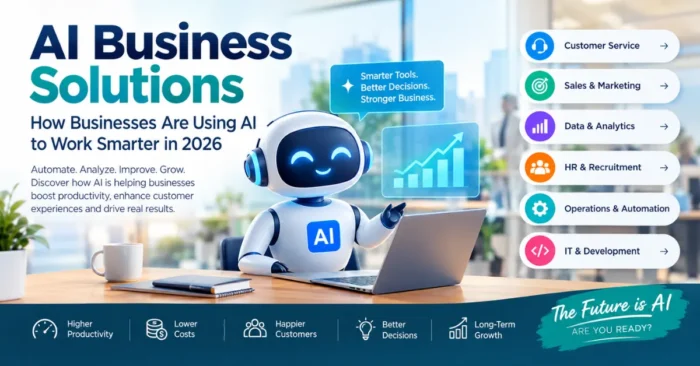
Artificial intelligence isn’t a side experiment anymore. In 2026, AI business solutions have quietly become part of how companies operate day to day—automating repetitive work, making sense of messy data, improving customer experiences, supporting employees, and helping teams make faster decisions.
The real shift isn’t just that AI can write text or answer questions. Modern AI systems can connect to business data and software, follow multi-step workflows, use tools, and actually complete tasks—with humans staying in the loop where it matters.
Industry research backs this up. OpenAI reports that enterprise AI use is becoming more agentic, and Microsoft’s 2026 Work Trend Index highlights how quickly AI agents are spreading inside organizations.
So what exactly are AI business solutions, and how can a company put them to work without wasting time and money?
What Are AI Business Solutions?
AI business solutions are AI-powered tools, systems, and services built to solve specific business problems or improve how work gets done.
Instead of treating AI as a standalone chatbot, companies are weaving it into areas like:
- Customer service
- Sales and lead generation
- Marketing and content creation
- Data analysis and reporting
- Human resources
- Finance and accounting
- Operations and workflow automation
- Software development
- Research and knowledge management
- IT support
Here’s the thing: the best solution isn’t necessarily the most advanced AI model. It’s the one that solves a real problem, fits into existing workflows, protects sensitive information, and delivers results you can actually measure.
Why AI Business Solutions Matter in 2026
Businesses are under constant pressure to do more with less. Customers expect faster responses. Employees need quick access to information. Management wants better insights from data that keeps piling up.
AI helps address these challenges by reducing manual work and giving employees backup with analysis, research, content generation, decision support, and automation.
The numbers tell a clear story. Microsoft’s 2026 Work Trend Index found that active agents in the Microsoft 365 ecosystem grew 15 times year over year. Their research also found that 66% of surveyed AI users said AI allowed them to spend more time on high-value work.
Meanwhile, McKinsey’s 2026 global AI survey reported that 40% of respondents from organizations with more than $1 billion in annual revenue said they were scaling AI agents—up from 27% the previous year.
These developments point to something important: businesses are starting to see AI not just as a productivity tool, but as part of their operating model.
Types of AI Business Solutions
1. AI Customer Service Solutions
Customer support is one of the most practical places to start with AI. AI-powered systems can answer common questions, summarize customer conversations, classify support requests, retrieve information, and route complex cases to human representatives.
More advanced AI agents can also interact with approved business systems and take specific actions. For example, an agent could check an order status, update a support ticket, or help resolve a billing issue before escalating to a human.
The goal shouldn’t be to remove humans from customer service entirely. Instead, let AI handle predictable tasks while employees focus on complicated or sensitive situations.
2. AI Sales and Lead Generation
Sales teams deal with enormous amounts of information every day. AI business solutions can help identify potential customers, research accounts, summarize CRM records, qualify leads, personalize outreach, and prepare sales reps for meetings.
For example, an AI system could review a prospect’s available information and prepare a short briefing containing:
- Company background
- Potential business needs
- Relevant products or services
- Previous interactions
- Suggested talking points
This cuts down preparation time and lets salespeople spend more time building relationships.
3. AI Marketing Solutions
Marketing teams can use AI throughout the content and campaign lifecycle.
Common applications include:
- Keyword and topic research
- Content ideation
- Content briefs
- Copywriting assistance
- Email personalization
- Audience segmentation
- Campaign analysis
- Competitor research
- Performance reporting
That said, AI-generated marketing content still needs human review. Brand voice, accuracy, originality, factual claims, and customer relevance should remain central to the editorial process.
4. AI Data Analysis and Business Intelligence
Businesses collect massive amounts of data, but having data isn’t the same as understanding it.
AI business solutions can help teams analyze datasets, spot trends, summarize reports, detect unusual patterns, and turn complicated information into insights that are easier to understand.
A manager could ask a business intelligence system a question in natural language instead of manually digging through multiple spreadsheets and dashboards.
The value comes from making business information easier to understand and act on—not just generating another report.
5. AI Workflow Automation
Workflow automation is becoming one of the most important areas of business AI.
Instead of asking an AI tool to perform one isolated task, companies can create workflows where AI handles several steps.
For example:
- A new customer submits a form.
- AI analyzes the information.
- The lead is categorized according to predefined criteria.
- The CRM record is updated.
- A personalized response is drafted.
- The sales team is notified.
Depending on the workflow and permissions, some steps can happen automatically while higher-risk decisions still require human approval.
6. AI Solutions for Human Resources
HR teams can use AI to support recruitment, employee onboarding, internal knowledge management, training, and administrative tasks.
AI can help summarize job applications, generate interview questions, create onboarding materials, answer routine employee questions, and organize internal documentation.
Because employment decisions affect people’s careers, companies should keep appropriate human oversight and avoid letting AI make sensitive decisions without proper review.
7. AI for Software Development and IT
Software development has become one of the most visible areas of enterprise AI adoption.
Developers can use AI to explain code, generate tests, identify potential bugs, refactor existing code, document systems, and assist with larger development tasks.
In 2026, agentic coding is also becoming more prominent. McKinsey reports that about two in ten organizations surveyed are scaling software coding agents, with adoption higher among large enterprises.
AI can accelerate development, but generated code still needs testing, security review, and human accountability.
AI Assistants vs. AI Agents
One of the biggest developments in AI business solutions is the shift from assistants to agents.
An AI assistant generally responds to a user’s request. For example, an employee might ask an AI assistant to summarize a document or write an email.
An AI agent can go further. With the right tools and permissions, it may gather information, interact with business applications, complete multiple steps, and return the finished result for review.
OpenAI’s 2026 enterprise research describes this transition as a move from asking AI for help toward having AI carry out more substantive work. The research also emphasizes the importance of connecting agents to company context and tools while maintaining permissions, governance, and human review.
Benefits of AI Business Solutions
When implemented properly, AI can deliver several practical benefits.
Greater Productivity
Employees can spend less time on repetitive research, documentation, data processing, and administrative work.
Faster Decision-Making
AI can help organize and analyze information so teams can identify relevant insights more quickly.
Lower Operational Costs
Automating suitable repetitive processes can reduce the manual effort required for routine tasks.
Better Customer Experiences
AI can provide faster responses and more personalized interactions while allowing human employees to focus on complex customer needs.
Scalable Operations
AI-powered workflows can help businesses handle growing volumes of work without increasing every operational resource at the same rate.
More Time for High-Value Work
Perhaps the most important benefit is allowing people to spend more time on strategy, creativity, relationships, judgment, and other activities where human expertise matters.
How to Choose the Right AI Business Solution
Buying an AI tool just because it’s popular can be an expensive mistake. Start with the business problem, not the technology.
Ask these questions before choosing a solution:
- What specific problem are we trying to solve?
- How much time or money does the current process consume?
- Does AI actually improve the process?
- What data will the system need?
- Does the solution integrate with our existing software?
- What level of human approval is required?
- How will we measure success?
- What privacy and security risks need to be addressed?
- Can the solution scale as the business grows?
A small, measurable AI project is often a better starting point than trying to automate an entire department at once.
How to Implement AI in a Business
A practical implementation process can look like this:
Step 1: Identify a High-Value Use Case
Look for repetitive, time-consuming, information-heavy processes where AI can provide a clear advantage.
Step 2: Establish a Baseline
Measure how the current process performs. Track factors such as time, cost, error rate, response time, conversion rate, or employee workload.
Step 3: Choose the Technology
Select an AI model, platform, agent framework, automation tool, or customized solution based on actual requirements.
Step 4: Connect the Necessary Data and Tools
AI becomes considerably more useful when it has controlled access to relevant business information and systems.
Step 5: Add Governance and Human Review
Define what the AI is allowed to do, what requires approval, what information it can access, and when a human must take over.
Step 6: Test Before Scaling
Start with a limited workflow. Test accuracy, security, reliability, cost, and user experience before expanding.
Step 7: Measure Business Results
Don’t measure an AI project only by how impressive the technology looks. Measure whether it improves an actual business outcome.
AI Business Solutions and ROI
Return on investment remains one of the biggest challenges for companies adopting AI.
A successful AI project should have a measurable connection to business value. Depending on the use case, relevant metrics might include:
- Hours saved per employee
- Cost per customer interaction
- Lead conversion rate
- Customer response time
- Sales productivity
- Content production time
- Error rates
- Customer satisfaction
- Revenue generated
- Operational costs
McKinsey’s 2026 research highlights the continuing focus on moving from AI experimentation toward measurable business value and ROI.
Challenges of Using AI in Business
AI business solutions can create significant value, but they also introduce new risks.
Data Privacy
Businesses need clear policies about what information can be provided to AI systems and how company and customer data is protected.
Accuracy
AI systems can produce incorrect or misleading information. Important outputs should be checked before they influence customers, finances, legal matters, or other high-impact decisions.
Security
AI agents that can access business systems require carefully controlled permissions. An agent with too much access can create unnecessary operational and security risks.
Employee Adoption
Technology alone doesn’t transform an organization. Employees need training, clear guidelines, and enough freedom to experiment responsibly.
Governance
Organizations should establish rules covering AI usage, access controls, monitoring, evaluation, data handling, and human accountability.
Microsoft’s 2026 research emphasizes that organizational culture, management support, and talent practices can have a stronger relationship with reported AI impact than individual behavior alone.
The Future of AI Business Solutions
The next phase of business AI will likely focus less on standalone chatbots and more on integrated AI systems that understand business context and participate in complete workflows.
That doesn’t mean every business needs hundreds of autonomous agents. In many cases, a well-designed workflow with clear boundaries and human oversight will deliver more value than a highly autonomous system.
The competitive advantage will increasingly come from how well companies combine AI with their own data, processes, expertise, and customer knowledge.
In other words, the question is changing from “How can we use AI?” to “Which business outcomes can we improve by redesigning this workflow around AI and human expertise?”
Frequently Asked Questions About AI Business Solutions
What are AI business solutions?
AI business solutions are AI-powered tools, platforms, and systems designed to solve business problems or improve processes such as customer service, marketing, sales, data analysis, operations, HR, and IT.
How can AI help a small business?
Small businesses can use AI for customer support, content creation, lead qualification, marketing automation, research, data analysis, appointment management, and administrative tasks. The best starting point is usually a repetitive process with a clear measurable cost.
What is an AI agent?
An AI agent is a system that can perform multi-step tasks using AI reasoning, business data, software tools, and predefined permissions. Unlike a basic chatbot, an agent may be able to take actions rather than simply provide information.
Are AI business solutions expensive?
The cost varies significantly. Some businesses can start with affordable off-the-shelf AI software, while larger organizations may invest in customized integrations and enterprise AI infrastructure. The important question is whether the expected business value justifies the cost.
Can AI completely replace employees?
AI can automate some tasks, but complete job replacement isn’t the right assumption for every business process. Many organizations are using AI to augment employees, automate routine work, and allow people to focus on judgment, creativity, relationships, and higher-value activities.
Is AI safe for business use?
AI can be used safely when organizations implement appropriate security, privacy controls, access permissions, monitoring, testing, and human oversight. Businesses should assess risks based on the specific AI application and the sensitivity of the information involved.
How do I start using AI in my business?
Start by identifying one repetitive or expensive workflow where AI could produce a measurable improvement. Define the current baseline, test an appropriate solution, establish human review and security controls, and measure the results before expanding.
What is the difference between AI automation and AI business solutions?
AI automation generally refers to using AI to automate particular tasks or workflows. AI business solutions is a broader term that can include automation as well as AI-powered analytics, customer service, decision support, software development, marketing, and other business applications.
Final Thoughts
AI business solutions are moving from experimentation into everyday business operations. In 2026, the most interesting development isn’t simply that AI can write, summarize, or answer questions. AI systems are increasingly being connected to company data, software, and repeatable workflows so they can help execute real business processes.
But successful AI adoption isn’t about automating everything. It’s about finding the right balance between AI capability and human judgment.
Businesses that start with practical use cases, protect their data, establish clear governance, train employees, and measure outcomes will be in a much stronger position to turn AI investment into sustainable business value.
For most organizations, the best time to explore AI business solutions isn’t when every process can be automated. It’s when there’s a specific business problem that AI can solve better, faster, or more efficiently than the current approach.