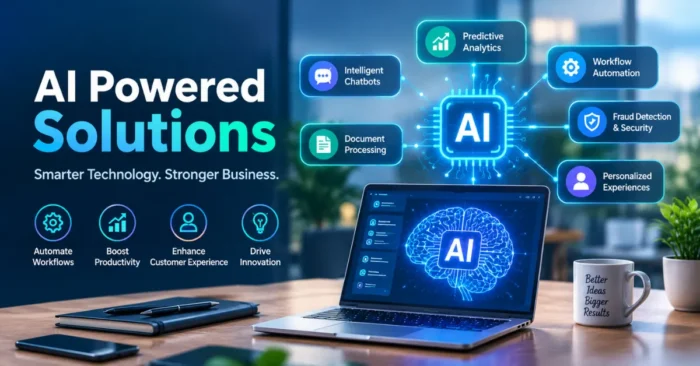
AI powered solutions are changing the way businesses operate, serve customers, analyze information, and make decisions. From intelligent chatbots and automated workflows to predictive analytics and AI-powered applications, companies of all sizes can use artificial intelligence to cut down on repetitive work and improve business performance.
Artificial intelligence in business now covers technologies like machine learning, natural language processing, generative AI, predictive analytics, computer vision, and intelligent automation. Businesses are increasingly using these technologies to streamline operations, improve customer experiences, generate insights, and create new products and services.
In this guide, we’ll explore what AI powered solutions are, the most common types, their benefits, business use cases, implementation strategies, costs, challenges, and how to choose the right solution for your organization.
What Are AI Powered Solutions?
AI powered solutions are software systems, applications, platforms, or business processes that use artificial intelligence to perform tasks that traditionally require human intelligence.
These solutions can analyze large amounts of information, recognize patterns, understand natural language, generate content, make predictions, automate processes, and assist people with complex decisions.
Unlike traditional software that generally follows predefined rules, AI systems can use data and models to identify patterns and produce intelligent outputs. Modern AI solutions can also connect with business systems and perform actions through approved workflows.
Examples include:
- AI customer service chatbots
- AI sales assistants
- Automated document processing
- Predictive analytics platforms
- AI recommendation systems
- Generative AI applications
- AI fraud detection systems
- Intelligent workflow automation
- AI-powered search and knowledge systems
- Computer vision applications
Why Are AI Powered Solutions Important?
Businesses generate enormous amounts of information every day. Employees also spend a lot of time on repetitive activities—responding to routine questions, entering data, preparing reports, processing documents, qualifying leads, and searching for information.
AI can help organizations handle these activities more efficiently while letting employees focus on work that requires creativity, judgment, communication, and strategic thinking.
Modern business AI is increasingly focused on practical outcomes rather than technology experimentation. Organizations are using AI for workflow automation, customer experience, forecasting, analytics, content creation, cybersecurity, and decision support.
Types of AI Powered Solutions
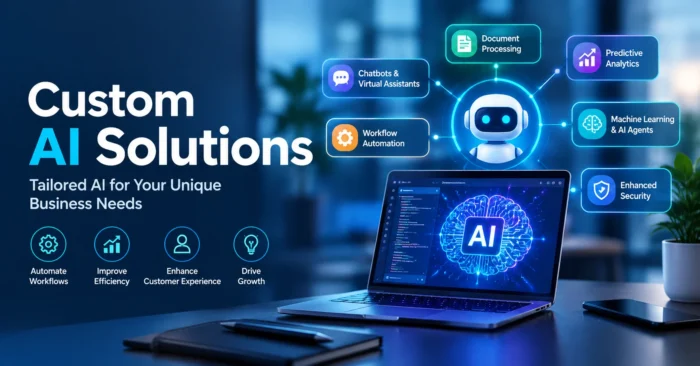
1. AI Chatbots and Virtual Assistants
AI chatbots are among the most common AI powered solutions used by businesses. They can communicate with customers through websites, messaging platforms, mobile applications, and other digital channels.
Modern AI assistants can understand natural language and provide answers based on business information. They can also collect customer information, qualify leads, schedule appointments, answer frequently asked questions, and transfer complex issues to human employees.
For example, an online store can use an AI assistant to answer product questions, provide order information, and help customers choose suitable products.
2. AI Workflow Automation
AI workflow automation combines artificial intelligence with business process automation. Instead of simply following fixed rules, AI can understand information and determine what action should happen next within defined permissions.
Businesses can use AI powered solutions to automate activities such as:
- Lead qualification
- Email classification
- Customer follow-ups
- Invoice processing
- Report generation
- Data entry
- CRM updates
- Document routing
This can reduce manual workloads and allow employees to spend more time on higher-value activities.
3. Generative AI Solutions
Generative AI can create new content based on instructions and available information. Businesses can use it for text, images, summaries, product descriptions, marketing materials, internal documentation, and other content-related tasks.
For example, a marketing team could use an AI powered solution to generate multiple versions of an advertisement, summarize research, create content outlines, or personalize communications.
Human review remains important, particularly when content involves sensitive, legal, financial, or customer-facing information.
4. Predictive Analytics
Predictive AI solutions analyze historical and current data to identify patterns and estimate possible future outcomes.
Businesses can use predictive analytics for:
- Sales forecasting
- Demand forecasting
- Customer churn prediction
- Risk assessment
- Inventory planning
- Fraud detection
- Equipment maintenance
Predictive analytics can help organizations make decisions based on data rather than relying entirely on assumptions or historical intuition.
5. AI Data Analytics
AI can make business data easier to understand. Instead of manually reviewing spreadsheets and dashboards, employees can ask questions using natural language and receive relevant insights.
An AI analytics system might identify unusual sales activity, compare regional performance, detect changes in customer behavior, or summarize important business trends.
This can make data analysis accessible to employees who don’t have advanced technical or statistical skills.
6. Intelligent Document Processing
Businesses often deal with large numbers of invoices, contracts, applications, receipts, forms, and other documents.
AI powered solutions can extract information from these documents, classify them, summarize their contents, and send relevant information to business systems.
This can significantly reduce manual data entry and make document-heavy processes faster and more consistent.
7. AI Recommendation Systems
Recommendation engines analyze customer behavior and preferences to suggest relevant products, services, content, or actions.
E-commerce companies can recommend products based on browsing and purchasing behavior. Streaming platforms can recommend content. Financial applications can provide personalized insights.
Personalization can improve customer engagement and create more relevant experiences.
8. AI Cybersecurity Solutions
AI can also support cybersecurity by analyzing activity, identifying unusual behavior, detecting potential threats, and helping security teams prioritize alerts.
Because cyber threats can change rapidly, AI can help organizations process large quantities of security information more efficiently.
9. Computer Vision Solutions
Computer vision enables software to interpret information from images and video.
Businesses can use computer vision for quality inspection, security monitoring, inventory management, medical imaging, manufacturing, and other applications where visual information is important.
10. AI Agents
AI agents represent a newer category of AI powered solutions. Rather than simply generating an answer, an AI agent can be designed to plan a task, use approved tools, retrieve information, and complete multiple steps in a workflow.
For example, an AI sales agent might research a lead, retrieve relevant customer information, prepare a personalized follow-up, and update a CRM after receiving the appropriate permissions.
Successful agentic systems require clear boundaries, reliable data, access controls, monitoring, and human approval for sensitive actions.
Benefits of AI Powered Solutions
Increased Productivity
AI can automate repetitive tasks and help employees complete information-heavy work faster. Instead of spending hours performing routine activities, employees can focus on tasks that require human judgment and creativity.
Reduced Operational Costs
Automation can reduce the amount of manual work required for repetitive processes. Over time, this can help organizations control operational costs while increasing the amount of work their teams can handle.
Better Customer Experience
AI assistants can provide faster responses and support customers outside normal business hours. Personalized recommendations and intelligent customer service can also make interactions more relevant.
Faster Decision-Making
AI can process large quantities of information quickly and highlight important trends, anomalies, and patterns. This gives decision-makers more information when evaluating business opportunities or risks.
Improved Accuracy
Automation can reduce errors associated with repetitive manual data entry and processing.
AI Powered Solutions for Small Businesses
AI isn’t limited to large enterprises with dedicated artificial intelligence departments. Small and medium-sized businesses can also benefit from practical AI applications.
For a small business, useful starting points may include:
- Website AI chatbots
- Automated lead follow-ups
- AI email assistance
- Social media content support
- Invoice and document processing
- Customer feedback analysis
- Appointment scheduling
- Sales forecasting
- AI-powered internal knowledge bases
The best approach is usually to begin with a specific business problem instead of trying to introduce AI everywhere at once.
AI Powered Solutions Across Different Industries
| Industry | Common AI Applications |
|---|---|
| Healthcare | Medical document analysis, virtual assistants, predictive analytics |
| Finance | Fraud detection, risk analysis, customer service, compliance |
| Retail | Recommendations, demand forecasting, customer support |
| Manufacturing | Quality inspection, predictive maintenance, process optimization |
| Real Estate | Lead qualification, property recommendations, market analysis |
| Education | AI tutoring, content generation, student support |
| Logistics | Route optimization, demand forecasting, document automation |
| Marketing | Content creation, customer segmentation, campaign analysis |
| Professional Services | Document analysis, research, reporting, workflow automation |
AI Powered Solutions vs. Traditional Software
| Traditional Software | AI Powered Solutions |
|---|---|
| Usually follows predefined rules | Can identify patterns and generate intelligent outputs |
| Often requires structured inputs | Can work with text, documents, images, audio, and other data |
| Limited adaptability | Can support more flexible and context-aware workflows |
| Automation is generally rule-based | Automation can incorporate AI reasoning and classification |
| Primarily executes programmed functions | Can analyze information and assist with decisions |
Traditional software remains essential. In many cases, the strongest business systems combine conventional software with AI capabilities rather than replacing existing technology completely.
Custom AI Powered Solutions
Businesses with specialized requirements may need custom AI powered solutions instead of relying entirely on off-the-shelf software.
A custom solution can be designed around a company’s workflows, data, customers, industry requirements, and existing technology.
Examples include:
- Custom AI customer support systems
- Internal company knowledge assistants
- AI-powered business intelligence platforms
- Industry-specific predictive models
- Custom document processing systems
- AI-powered CRM automation
- Specialized recommendation engines
- AI agents connected to business applications
Custom development generally requires more planning and investment, but it can provide greater control and a closer fit with complex business processes.
How to Choose the Right AI Powered Solution
Choosing an AI solution should begin with the business problem rather than the technology.
1. Identify the Problem
Determine which process is creating the most significant cost, delay, inefficiency, or customer frustration.
2. Evaluate the Data
AI depends heavily on data. Determine what information is available, where it’s stored, how reliable it is, and whether it can legally and securely be used for the intended purpose.
3. Define the Expected Outcome
Establish measurable goals. For example, a company might want to reduce response times, increase qualified leads, lower processing costs, or reduce manual data entry.
4. Consider Integration
The solution should work with existing systems such as CRMs, accounting software, websites, databases, communication platforms, and internal applications.
5. Review Security and Privacy
Businesses should consider access controls, data protection, compliance requirements, monitoring, and how information is stored and processed.
6. Start Small
A focused pilot project can help determine whether an AI solution delivers measurable value before the organization invests in a larger deployment.
How to Implement AI Powered Solutions Successfully
Successful AI implementation involves more than selecting an AI model or software platform.
- Define a clear business objective.
- Identify the right AI use case.
- Collect and prepare reliable data.
- Select the appropriate technology.
- Integrate the solution with existing workflows.
- Test performance before full deployment.
- Train employees and define responsibilities.
- Monitor results continuously.
- Improve the system based on real-world feedback.
Governance should also be considered from the beginning. Businesses need to understand what the AI is allowed to do, which decisions require human approval, and how errors will be detected and handled.
How Much Do AI Powered Solutions Cost?
The cost of AI powered solutions can vary significantly depending on the technology, complexity, integrations, data requirements, and level of customization.
A simple AI chatbot may require a relatively small investment, while a custom enterprise AI platform can require substantial development and infrastructure resources.
Typical cost factors include:
- AI software or model usage
- Custom application development
- Data preparation
- API integrations
- Cloud infrastructure
- Security and compliance
- Testing and evaluation
- Employee training
- Ongoing monitoring and maintenance
Instead of focusing only on the initial cost, businesses should evaluate the potential return on investment. A solution that costs more but saves significant employee time or generates additional revenue may provide better long-term value.
Challenges of AI Powered Solutions
Despite their potential, AI systems aren’t automatically successful. Businesses need to plan for several challenges.
Data Quality
Poor-quality or incomplete data can reduce the effectiveness of AI systems. Data preparation is often one of the most important parts of an AI project.
Security and Privacy
Sensitive business and customer information must be protected. Organizations should carefully evaluate how AI systems access, store, and process data.
Accuracy
Generative AI systems can sometimes produce incorrect or misleading information. Important outputs should therefore be evaluated and, when necessary, reviewed by humans.
Integration Complexity
Connecting AI to older business systems can be challenging. APIs, databases, permissions, and existing workflows may all need to be considered.
Employee Adoption
Technology alone doesn’t create business value. Employees need to understand how and when to use AI and how their responsibilities change when automation is introduced.
Ongoing Maintenance
AI solutions require monitoring and improvement. Business data, customer expectations, models, security threats, and workflows can all change over time.
The Future of AI Powered Solutions
The future of AI in business is moving beyond individual tools toward connected intelligent systems.
Businesses are increasingly exploring AI agents, multimodal AI, intelligent workflow automation, AI-powered knowledge systems, predictive analytics, and domain-specific AI applications.
Rather than using AI only as a standalone chatbot, organizations can integrate AI directly into their business processes. An AI system may retrieve information, analyze it, make a recommendation, interact with another application, and request human approval before completing a sensitive action.
This shift means businesses will increasingly focus on how AI fits into their overall operations rather than simply asking which AI model they should use.
Frequently Asked Questions About AI Powered Solutions
What are AI powered solutions?
AI powered solutions are software applications, platforms, or workflows that use artificial intelligence to automate tasks, analyze information, generate content, make predictions, support decisions, or improve customer experiences.
What are examples of AI powered solutions?
Examples include AI chatbots, virtual assistants, predictive analytics, recommendation engines, intelligent document processing, AI workflow automation, fraud detection, generative AI applications, and AI agents.
Are AI powered solutions useful for small businesses?
Yes. Small businesses can use AI to automate customer service, lead management, content creation, document processing, reporting, scheduling, and other repetitive activities without building a large internal AI department.
Can AI powered solutions be customized?
Yes. Businesses can customize AI systems by connecting them to their own data, workflows, applications, knowledge bases, and business rules. Highly specialized requirements may justify a completely custom AI solution.
Are AI powered solutions difficult to implement?
The difficulty depends on the use case. A simple chatbot or AI writing assistant may be easy to introduce, while an enterprise AI system connected to multiple databases and business applications can require significant planning and development.
Is AI going to replace employees?
AI is more commonly used to automate or assist specific tasks rather than replace every aspect of a job. In many organizations, the most effective approach is to combine AI capabilities with human judgment, creativity, communication, and oversight.
How should a business get started with AI?
Start with a specific business problem that can be measured. Identify the available data, evaluate potential AI solutions, run a small pilot, measure the results, and scale the approach if it delivers meaningful value.
Conclusion
AI powered solutions are becoming an important part of modern business technology. They can help organizations automate repetitive work, improve customer experiences, analyze data, make better predictions, and develop new ways of working. Businesses should identify valuable use cases, prepare reliable data, establish appropriate security and governance, integrate AI into existing workflows, and measure the results.
The goal isn’t simply to use AI. The goal is to use AI where it creates measurable business value.