
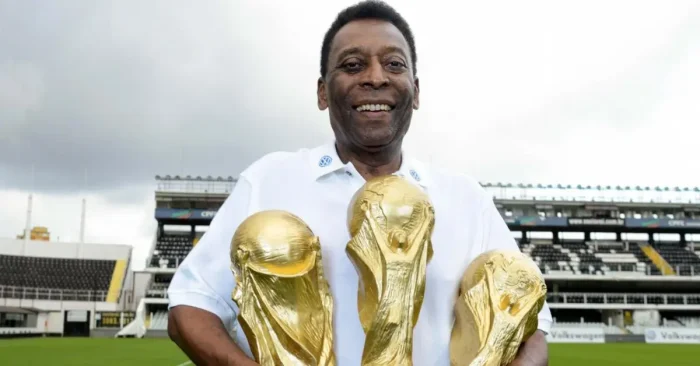
Pele Career and Life Style
Early Life and Background
Edson Arantes do Nascimento, known worldwide as Pele, was born on October 23, 1940, in Três Corações, Minas Gerais, Brazil. Raised in a modest family, he showed extraordinary football talent from a young age, honing his skills on the streets and in local games. Supported by his father and inspired by local players, Pele’s early years laid the foundation for a career that would redefine forward play and help Brazil become a football powerhouse.
Rise to Fame in Pele Biography
Pele rose to international fame in the late 1950s after joining Santos FC at age 15. His goal-scoring prowess and creative play quickly drew global attention, and at 17 he helped Brazil win the 1958 FIFA World Cup, becoming the youngest player to lift the trophy. This breakout moment established him as a prodigy and a national icon for Brazil, launching a decades-long career that would shape world football.
Football Career and Achievements
A major highlight of Pele’s career is his prolific time with Santos FC, where he scored over 600 goals and collected numerous titles. He also brought football to a wider audience in the United States with the New York Cosmos. Representing Brazil, he won three FIFA World Cups (1958, 1962, 1970), a record that stands as a benchmark for greatness. His blend of skill, vision, and consistency solidified his status as one of football’s all-time greats.
Playing Style and Influence
Pele’s playing style combined technical skill, speed, creativity, and tactical intelligence, redefining the modern forward. Renowned for powerful shots, deft dribbling, and clinical finishing, he influenced generations of players worldwide, including Neymar Biography. His impact extended beyond the pitch, shaping football as both a sport and a cultural phenomenon.
Personal Life
Off the field, Pele balanced family life and philanthropy. He married twice and had several children, while dedicating time to education, sports, and social causes worldwide. Even after reaching global fame, he remained connected to his Brazilian roots and frequently spoke about the importance of family and community. His personal values and public persona contributed to his enduring global admiration. His legacy continues alongside contemporary stars such as Kylian Mbappé Biography.
Awards and Recognition
Pele’s awards and recognition include the FIFA World Cup titles and numerous individual honors. He was named FIFA Player of the Century (1999), shared with Diego Maradona Biography, and was celebrated by football bodies and governments for his contributions to the sport and charitable work.
Legacy and Cultural Impact
The legacy of Pele’s life centers on his influence as one of the greatest athletes in history. He popularized football internationally, inspired countless players, and became a symbol of excellence and sportsmanship. Pelé’s cultural impact extends beyond sports, representing the power of talent, determination, and dedication. His achievements left an indelible mark on football and global culture. Pelé passed away on December 29, 2022, but his legacy continues to inspire new generations around the world, including rising talents such as Lionel Messi Biography and Vinícius Júnior Biography.
Frequently Asked Questions (FAQs)
When was Pele born?
Pele was born on October 23, 1940, in Três Corações, Minas Gerais, Brazil.
How did Pele become famous?
He became famous as a teenager playing for Santos FC and helping Brazil win the 1958 FIFA World Cup at age 17.
What are Pele’s major achievements?
Pele won three FIFA World Cups (1958, 1962, 1970), scored over 600 goals for Santos FC, and received numerous global awards.
What was Pele’s playing style?
He combined technical skill, speed, creativity, and goal-scoring instincts, redefining the forward position in football.
What is Pele’s legacy?
Pele’s legacy is his influence on football, inspiring generations of players, popularizing the sport globally, and leaving a lasting cultural impact.