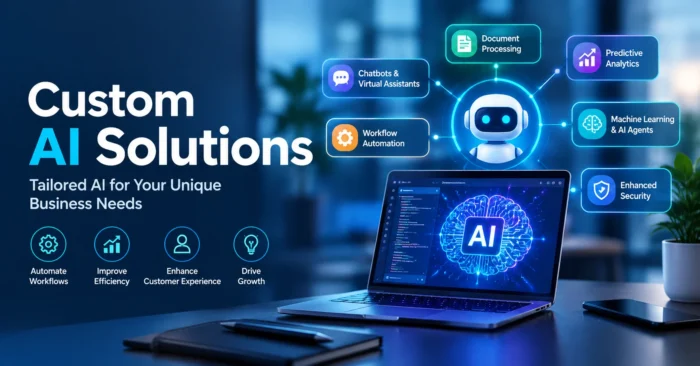
Artificial intelligence isn’t just for the big tech companies anymore. Businesses of all sizes are using AI to automate repetitive work, improve customer experiences, analyze data, and make faster decisions. But here’s the catch—off-the-shelf AI tools don’t always fit the way every business operates. That’s where custom AI solutions come in.
Custom AI solutions are built around a company’s specific goals, workflows, data, and existing software. Instead of forcing your business to adapt to a generic AI platform, custom AI lets the technology adapt to you.
From intelligent customer support and document processing to predictive analytics, AI agents, recommendation engines, and workflow automation, customized artificial intelligence can solve problems that traditional software just can’t handle efficiently.
In this guide, we’ll walk through what custom AI solutions are, how they work, their main benefits, common use cases, implementation costs, challenges, and how businesses can choose the right approach.
What Are Custom AI Solutions?
Custom AI solutions are artificial intelligence systems developed or configured specifically for the needs of an individual business, organization, product, or industry.
Unlike a general-purpose AI application, a custom solution can be built around your proprietary data, business rules, workflows, software systems, and customer requirements.
For example, an e-commerce company might use a custom AI system to recommend products based on customer behavior. A financial company could use AI to spot suspicious transactions. A healthcare organization might use AI to process documents and assist with administrative workflows.
And here’s something important: custom AI doesn’t necessarily mean building a completely new AI model from scratch. In many cases, businesses can combine existing AI models with their own data, APIs, databases, automation workflows, and applications to create a solution tailored to a particular use case.
Why Are Businesses Investing in Custom AI Solutions?
Generic AI tools can be useful for everyday tasks, but businesses often have more complex requirements. They may need AI to work with internal databases, proprietary documents, customer records, legacy applications, or industry-specific processes.
A custom AI solution can connect these systems and provide intelligence where it’s actually needed.
Businesses typically explore customized AI for several reasons:
- Automating repetitive and time-consuming processes
- Reducing operational costs
- Improving customer service
- Analyzing large amounts of business data
- Creating personalized customer experiences
- Making faster and more informed decisions
- Connecting AI with existing business software
- Building AI-powered products and services
- Gaining an advantage over competitors
The strongest custom AI projects usually start with a specific business problem rather than simply adopting AI because it’s popular.
What Are the Best Custom AI Solutions?
There’s no single custom AI solution that works for every organization. The right system depends on your industry, objectives, data, budget, and existing technology.
That said, some of the most common types of custom AI solutions include the following.
1. Custom AI Chatbots and Virtual Assistants
Businesses can build AI-powered chatbots that understand their products, services, policies, and internal knowledge.
Unlike basic scripted chatbots, modern AI assistants can understand natural language and respond to a much wider range of questions.
A custom chatbot can be connected to your knowledge base, CRM, help desk, website, or internal systems. It can answer customer questions, qualify leads, assist employees, and route complex requests to human staff.
Common applications include:
- Customer support
- Lead qualification
- Appointment scheduling
- Product recommendations
- Employee help desks
- Internal knowledge search
- Frequently asked questions
2. AI Workflow Automation
Many organizations still depend on employees to manually move information between applications, review documents, send emails, update records, and complete repetitive administrative tasks.
Custom AI workflow automation can reduce this manual workload.
For example, an AI system could receive an invoice, extract relevant information, validate the data, update an accounting system, and send the document to the appropriate employee for approval.
AI-powered automation can be particularly useful when a workflow involves large volumes of unstructured information.
3. Custom AI Agents
AI agents represent a more advanced approach to business automation. Instead of simply generating an answer, an AI agent can be designed to perform multiple steps toward a specific objective.
Depending on its permissions and integrations, an agent might retrieve information, analyze it, interact with business applications, and perform approved actions.
Examples include:
- Sales qualification agents
- Customer service agents
- Research assistants
- IT support agents
- Operations agents
- Internal knowledge agents
- Document processing agents
Because these systems can interact with business tools, security, permissions, monitoring, and human approval processes are especially important.
4. Custom Predictive Analytics
Businesses generate enormous amounts of data, but raw data doesn’t automatically produce useful decisions.
Custom AI models can analyze historical and real-time information to identify patterns and generate predictions.
Examples include:
- Sales forecasting
- Demand forecasting
- Customer churn prediction
- Inventory forecasting
- Fraud detection
- Risk assessment
- Equipment failure prediction
Predictive AI can help organizations move from simply understanding what happened to estimating what’s likely to happen next.
5. AI Document Processing
Documents remain a major source of manual work for many organizations. Employees may spend hours reading invoices, contracts, forms, applications, reports, and other documents.
Custom AI document processing systems can extract information, classify documents, summarize content, identify important fields, and send information to other systems.
This can be useful in industries like finance, healthcare, insurance, legal services, logistics, and real estate.
6. AI Recommendation Engines
Recommendation systems can personalize the experience of individual users by analyzing their behavior, preferences, history, and interactions.
E-commerce companies can recommend products, streaming platforms can recommend content, and financial applications can personalize information or services.
A custom recommendation engine can be designed around your unique products, customers, business rules, and objectives.
7. Custom Computer Vision Solutions
Computer vision allows AI systems to interpret images and video.
Businesses can develop customized computer vision systems for applications like quality inspection, object detection, inventory monitoring, security analysis, and visual classification.
Manufacturing companies, retailers, logistics providers, healthcare organizations, and other industries can benefit from computer vision when visual information plays an important role in their operations.
8. Custom Natural Language Processing Solutions
Natural language processing, or NLP, enables computers to understand and process human language.
Businesses can use custom NLP systems to classify messages, analyze customer feedback, summarize documents, extract information, search internal knowledge, and process large volumes of text.
For organizations with industry-specific terminology or large proprietary document collections, customized NLP systems can provide more useful results than generic solutions.
Key Benefits of Custom AI Solutions
Custom AI development requires more planning than simply subscribing to an existing application, but it can provide significant advantages when the business problem justifies customization.
1. Designed Around Your Business
A custom AI system can be built around your actual workflows instead of requiring employees to change their processes to match generic software.
2. Better Integration
Custom solutions can connect with existing CRMs, ERPs, databases, websites, mobile applications, APIs, and internal systems.
3. Greater Flexibility
Businesses can decide which features, rules, integrations, and permissions the system needs. Additional capabilities can also be added as requirements evolve.
4. Improved Efficiency
Automating repetitive work allows employees to spend more time on tasks that require creativity, judgment, communication, and strategic thinking.
5. Better Use of Business Data
A customized AI system can turn internal business information into actionable insights, recommendations, predictions, or automated workflows.
6. Competitive Advantage
When AI is built around proprietary processes or data, competitors can’t necessarily reproduce the entire solution just by subscribing to the same software.
7. Scalability
A properly designed AI system can evolve as your business grows. New users, workflows, integrations, and AI capabilities can be added over time.
Custom AI Solutions by Industry
AI can be customized for almost any industry where there’s sufficient data, a repeatable process, or a problem that can benefit from prediction, classification, automation, or natural-language interaction.
Healthcare
Healthcare organizations can use AI for administrative automation, document processing, patient communication, scheduling, medical data analysis, and other carefully governed applications.
Finance and Fintech
Financial businesses can use custom AI for fraud detection, risk analysis, customer support, document processing, compliance workflows, financial forecasting, and personalization.
E-Commerce and Retail
Retail businesses can use AI for recommendations, demand forecasting, customer service, inventory management, personalization, and marketing automation.
Manufacturing
Manufacturers can use AI for predictive maintenance, quality inspection, production forecasting, supply chain optimization, and computer vision.
Real Estate
Real estate companies can use AI for lead qualification, property recommendations, document analysis, customer communication, market analysis, and workflow automation.
Education
Educational organizations can use custom AI assistants, tutoring systems, student analytics, content tools, administrative automation, and intelligent search.
Logistics and Supply Chain
AI can support route optimization, demand forecasting, inventory analysis, shipment monitoring, document processing, and operational decision-making.
Custom AI Solutions vs. Off-the-Shelf AI Tools
The choice between custom AI and an existing AI application depends on the complexity of your business requirement.
| Factor | Custom AI Solution | Off-the-Shelf AI Tool |
|---|---|---|
| Customization | Highly customizable | Usually limited to available features |
| Business-specific data | Can be deeply integrated | May have limited integration |
| Development time | Usually longer | Usually faster |
| Initial investment | Generally higher | Generally lower |
| Scalability | Can be designed around business growth | Depends on vendor capabilities |
| Integrations | Can be customized | Limited to supported integrations |
| Best for | Unique or complex business requirements | Common, straightforward use cases |
For a simple task, an existing AI tool may be the better option. A custom solution becomes more attractive when your business has unique processes, large proprietary datasets, complex integrations, or requirements that existing software can’t satisfy.
How to Choose the Right Custom AI Solution
Businesses shouldn’t begin with the question, “Which AI technology should we use?” A better starting point is, “Which business problem are we trying to solve?”
Consider the following factors:
Define the Business Objective
Identify the measurable outcome you want to achieve. This might be reducing customer support workload, increasing conversion rates, improving forecasting accuracy, or reducing document-processing time.
Evaluate Your Data
AI systems depend heavily on data. Determine what information is available, where it’s stored, how accurate it is, and whether it can legally and securely be used.
Identify Required Integrations
Consider which systems the AI needs to communicate with. These could include CRM platforms, accounting software, ERP systems, databases, websites, mobile applications, or internal APIs.
Consider Security and Privacy
Businesses should evaluate access controls, encryption, data handling, authentication, audit logs, model permissions, and regulatory requirements before deploying AI.
Measure ROI
Define how success will be measured. Useful metrics may include hours saved, cost reduction, revenue generated, conversion rate, customer satisfaction, processing accuracy, or response time.
How to Build a Custom AI Solution
A successful custom AI project generally follows a structured development process.
- Discovery: Identify the business problem and desired outcome.
- AI strategy: Determine whether AI is actually the right solution.
- Data assessment: Review available data and its quality.
- Solution architecture: Design the AI system and its integrations.
- Prototype: Build a small proof of concept to validate the approach.
- Development: Build the production-ready application or AI system.
- Integration: Connect the solution with existing business systems.
- Testing: Evaluate accuracy, reliability, security, and performance.
- Deployment: Launch the system in a controlled production environment.
- Monitoring: Track performance and continuously improve the system.
Starting with a focused pilot can reduce risk. Once the initial use case demonstrates measurable value, you can expand the solution to additional departments or workflows.
How Much Do Custom AI Solutions Cost?
There’s no universal price for custom AI development because the cost depends heavily on scope and technical complexity.
A simple AI chatbot connected to an existing knowledge base may cost significantly less than a large enterprise platform involving predictive models, multiple integrations, custom interfaces, complex security requirements, and large datasets.
Important cost factors include:
- AI model and infrastructure requirements
- Data preparation and processing
- Number of integrations
- Application development
- User interface requirements
- Cloud infrastructure
- Security requirements
- Testing and quality assurance
- Ongoing monitoring and maintenance
- Number of users and volume of AI requests
Businesses should evaluate custom AI based on expected business value rather than development cost alone. A system that saves hundreds of employee hours every month may justify a larger initial investment.
Challenges of Custom AI Development
Custom AI can provide substantial benefits, but it also introduces challenges.
Data Quality
Poor-quality, incomplete, outdated, or inconsistent data can reduce the effectiveness of an AI system.
Integration Complexity
Connecting AI to older software or multiple business systems can require significant technical work.
Security Risks
AI applications may interact with sensitive business or customer information, making security and access control essential.
Accuracy and Reliability
AI outputs should be tested carefully, especially when mistakes could affect financial, legal, healthcare, or other high-impact decisions.
Ongoing Maintenance
AI systems are not always “build once and forget.” Models, data, integrations, business rules, and user requirements can change over time.
Organizations should therefore plan for monitoring, evaluation, updates, and continuous improvement from the beginning.
What Does the Future Hold for Custom AI Solutions?
Custom AI is moving beyond simple chatbots and isolated automation tools. Businesses are increasingly exploring AI systems that can understand context, work with multiple sources of information, interact with software applications, and assist with multi-step processes.
AI agents are an important part of this evolution. Instead of only answering questions, future business systems will increasingly be able to coordinate tasks while operating within defined permissions and human oversight.
At the same time, organizations are likely to place greater emphasis on responsible AI, security, transparency, governance, and monitoring.
The result is likely to be a shift from using AI as a standalone tool toward embedding intelligence directly into everyday business operations.
Frequently Asked Questions About Custom AI Solutions
What are custom AI solutions?
Custom AI solutions are artificial intelligence systems designed or configured specifically for a business’s unique requirements. They can use company data, business rules, workflows, and integrations to solve specific problems.
Why choose custom AI instead of a standard AI tool?
Custom AI is useful when an organization’s requirements are too specific or complex for an existing tool. It can provide deeper customization, integration, control, and use of proprietary business data.
Can small businesses use custom AI solutions?
Yes. Small businesses don’t necessarily need large enterprise AI systems. A focused chatbot, workflow automation, document-processing system, or AI assistant can provide value without requiring a massive technology project.
Do custom AI solutions require building an AI model from scratch?
No. Many custom AI systems use existing AI models and combine them with business data, retrieval systems, APIs, databases, automation, and application logic. Building a model from scratch is only appropriate for certain specialized requirements.
How long does it take to build a custom AI solution?
The timeline depends on complexity. A focused proof of concept may be developed relatively quickly, while a production enterprise platform with multiple integrations, security controls, and extensive testing can take considerably longer.
Are custom AI solutions secure?
They can be designed with strong security controls, but security depends on architecture, implementation, data handling, access permissions, infrastructure, and ongoing monitoring. Organizations should conduct appropriate security and privacy reviews before deployment.
Can custom AI integrate with existing software?
Yes. One of the major advantages of custom AI is its ability to integrate with existing applications through APIs, databases, connectors, and other integration methods.
How can a business get started with custom AI?
The best starting point is usually a specific, measurable business problem. Identify a repetitive or expensive process, evaluate the available data, estimate the potential ROI, and develop a small proof of concept before expanding the system.
Conclusion
Custom AI solutions give businesses an opportunity to move beyond generic AI tools and build intelligent systems around their actual needs. Whether the goal is automating workflows, improving customer support, analyzing data, processing documents, predicting demand, or creating an AI-powered product, customization can make artificial intelligence significantly more useful.
The key is not to adopt AI simply because it’s available. Successful businesses start with a clear problem, measurable objectives, reliable data, appropriate technology, and a realistic implementation strategy.
For organizations with unique workflows or complex requirements, custom AI can become more than a productivity tool. It can become an intelligent layer across the business, helping employees work faster, improving customer experiences, and creating new opportunities for growth.