
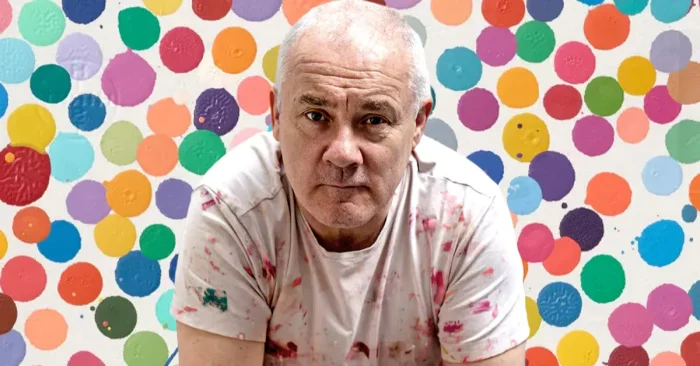
Damien Hirst – Biography
Early Life and Education of Damien Hirst
Damien Hirst was born on June 7, 1965, in Bristol, England, and raised in Leeds. His early years were marked by family upheaval, including his parents’ separation, with his mother as his primary caregiver. This period seeded a fascination with death and mortality that would recur throughout his art. After showing early interest in drawing and sculpture, he moved to London and enrolled at Goldsmiths, University of London, in 1986 to study fine art. Goldsmiths provided an environment that encouraged experimentation and non-traditional approaches, a culture echoed by contemporaries who would also come to redefine British art, such as David Hockney.
Emergence as a Leading Young British Artist
While still a student, Hirst organized an exhibition called “Freeze” in 1988, which featured works by himself and fellow Goldsmiths students. The show attracted the attention of influential art collectors and critics, notably Charles Saatchi, who would become Hirst’s major patron. “Freeze” is often credited with launching the Young British Artists (YBAs) movement, a group known for its provocative, boundary-pushing works. Hirst’s early pieces, which often incorporated preserved animal specimens, immediately set him apart as a fearless and innovative artist willing to confront uncomfortable subjects like death, decay, and mortality head-on. The Freeze show also helped shape the YBA cohort, bringing into focus peers such as Tracey Emin and Anish Kapoor, who would become prominent voices in contemporary art.
Breakthrough and Signature Works
Hirst’s most iconic works emerged in the early 1990s, particularly his use of animals preserved in formaldehyde. “The Physical Impossibility of Death in the Mind of Someone Living,” featuring a tiger shark suspended in a tank, became a symbol of contemporary art’s boldness. Other notable works, such as “Mother and Child (Divided),” featuring a bisected cow and calf, continued his exploration of life and death. Hirst’s confrontational style generated both acclaim and controversy, challenging traditional definitions of art. His work’s visceral impact, combined with his business acumen, helped him rise to global prominence in a short time. His approach to art and commerce has often drawn comparisons to other provocative figures in the field, including Jeff Koons.
Commercial Success and Global Recognition
By the late 1990s and early 2000s, Hirst had become one of the world’s most commercially successful artists. His partnership with Saatchi brought enormous attention and financial backing. In 2007, he created one of his most talked-about pieces, “For the Love of God,” a platinum cast of a human skull encrusted with over 8,000 diamonds. The piece reportedly sold for £50 million, symbolizing Hirst’s fusion of art, commerce, and spectacle. That same year, he made headlines by auctioning his works directly through Sotheby’s, bypassing galleries and generating over £111 million in sales. Hirst’s ability to blend artistic daring with financial savvy positioned him as a leading figure in contemporary art’s commercialization. His market profile and fearless experimentation have influenced peers across the spectrum, including Jeff Koons and other boundary-pushing artists.
Criticism and Evolving Reputation
Despite his success, Hirst has faced significant criticism throughout his career. Some critics accuse him of prioritizing shock value and commercialism over artistic substance. Accusations of using assistants to produce his work and allegations of unoriginality have sparked debates about authenticity in contemporary art. Nevertheless, Hirst remains unapologetic, viewing his work as a reflection of society’s fascination with wealth, mortality, and spectacle. Over time, he has expanded his practice, exploring painting, sculpture, and large-scale installations. His 2017 exhibition, “Treasures from the Wreck of the Unbelievable,” showcased elaborate underwater-themed sculptures, once again dividing critics and audiences over its ambition and extravagance.
Personal Life and Philanthropy
Hirst has three children from his previous relationship with designer Maia Norman. Despite his immense wealth, he maintains a relatively private personal life. He owns a large art studio and production company in London, employing numerous assistants. Beyond his art, Hirst has engaged in philanthropic efforts, supporting medical research and children’s charities. His financial success has allowed him to fund extensive creative projects, as well as contribute to causes that reflect his interest in health, life, and death—core themes of his artistic work.
Legacy and Influence
Damien Hirst’s influence on contemporary art is undeniable. As one of the most prominent figures of the YBA movement, he helped redefine what art could be in the late 20th and early 21st centuries. His willingness to challenge taboos, embrace commercial success, and provoke public debate has left a lasting mark on the art world. While his work remains polarizing, Hirst’s bold vision continues to inspire dialogue about the relationship between art, commerce, and mortality, ensuring his lasting place in modern art history. The reach of his influence extends to contemporary artists such as Jenny Saville.
Conclusion
Damien Hirst’s career exemplifies fearless exploration of life’s most profound and unsettling themes. From preserved animals to diamond-encrusted skulls, his work challenges audiences to confront their own views on death, beauty, and materialism. Beyond the works themselves, his market-driven approach has reshaped how contemporary art is created, sold, and discussed. Love him or criticize him, Hirst’s impact on contemporary art remains undeniable, securing his status as one of the most influential and provocative artists of his generation.
Frequently Asked Questions (FAQs)
What is Damien Hirst best known for?
He is best known for his preserved animals in formaldehyde tanks and provocative works exploring life and death.
What was “The Physical Impossibility of Death”?
It’s a 1991 artwork featuring a preserved tiger shark in formaldehyde, symbolizing mortality and fear.
How much did “For the Love of God” sell for?
The diamond-encrusted skull reportedly sold for £50 million, making it one of his most famous pieces.
Has Damien Hirst faced criticism?
Yes, some critics accuse him of prioritizing shock value and commercial success over artistic depth.
What is Damien Hirst’s legacy?
He is considered one of the most influential and controversial contemporary artists, reshaping the art world’s relationship with commerce and spectacle.