
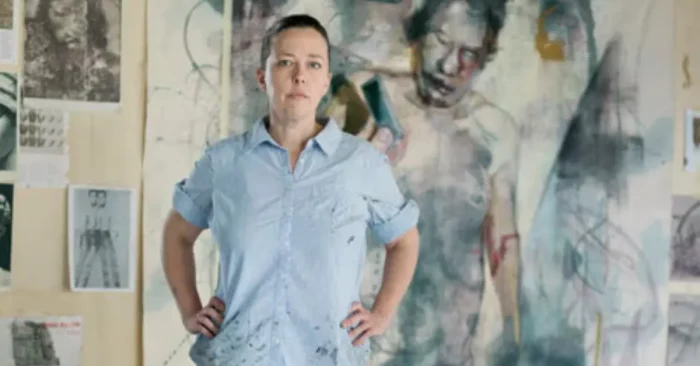
Jenny Saville – Biography
Early Life and Education
Jenny Saville was born in 1970 in Cambridge, England. From a young age, she showed a strong interest in art, leading her to study at the Glasgow School of Art, where she graduated in 1992. Her education focused on figurative painting, and she quickly gained recognition for her unique approach to depicting the human body. Influenced by classical painters and feminist theory, Saville developed a style that challenged traditional beauty standards and explored themes of identity, gender, and the physicality of the human form. This perspective echoes the feminist inquiries seen in the work of Louise Bourgeois.
Artistic Career and Style
Jenny Saville emerged in the 1990s as a key figure in the Young British Artists movement. She is best known for her large-scale, raw, and intense portraits of nude bodies. Her paintings often portray flesh in a way that confronts societal norms about beauty, size, and vulnerability. Saville uses bold brushwork and a muted palette to capture the imperfections and textures of skin, highlighting the physical realities of the human condition. Her work questions conventional ideas about femininity, creating a powerful commentary on body image and self-perception. As a central figure within the Young British Artists (YBA) scene, she was aligned with peers like Damien Hirst.
Major Works and Exhibitions
Over her career, Jenny Saville has produced numerous iconic works, such as “Propped” and “Strategy.” These paintings gained international acclaim for their emotional depth and technical mastery. Saville’s art has been exhibited worldwide in prestigious galleries, including the Tate Gallery in London and the Museum of Contemporary Art in Chicago. Her works are celebrated for their scale and the visceral impact they have on viewers, often evoking strong emotional responses. She continues to push boundaries with new projects that explore the relationship between body and identity. This trajectory has also placed her among artists who reshape narratives about embodiment, with peers like Louise Bourgeois and Tracey Emin cited as influences in broader conversations about body-centric storytelling.
Recognition and Influence
Jenny Saville’s impact on contemporary art is significant. She is considered one of the leading painters of her generation, influencing many artists who address the human body and identity. Her painting “Propped” has set notable auction records for a living female artist at auction, underscoring her importance in the art market. Saville’s work has been praised for challenging beauty norms and expanding the conversation around gender and representation in art. Her contributions continue to inspire discussions on feminism and body politics. In conversations about contemporary sculpture and painting, artists such as Louise Bourgeois and Tracey Emin are frequently cited as influences on broader narratives about embodiment and identity.
Personal Life and Philosophy
Saville maintains a relatively private personal life but has spoken openly about her artistic philosophy. She views painting as a means to explore deeper truths about human existence and experience. Her focus on the human form is not just about physical appearance but also about vulnerability, strength, and identity. Saville believes that art should provoke thought and challenge viewers, encouraging a more inclusive understanding of beauty and humanity. Her work remains deeply personal, yet universally resonant. As with fellow artists such as Tracey Emin, she emphasizes vulnerability and identity in her practice.
Conclusion
Jenny Saville’s career is a testament to the power of art to challenge societal norms and provoke meaningful conversations. Through her intense and evocative paintings, she has reshaped how the human body is portrayed in contemporary art. Her work champions diversity and authenticity, making her a vital voice in today\u2019s cultural landscape. As she continues to create, Saville’s influence on art and discussions about identity and beauty remains profound and enduring. Her impact is often discussed alongside pioneers like Louise Bourgeois and Tracey Emin for reshaping conversations about embodiment and feminism.
Frequently Asked Questions (FAQS)
Who is Jenny Saville?
Jenny Saville is a British contemporary painter known for her large-scale portraits that challenge traditional views of the human body.
What style of art does Jenny Saville create?
She is famous for her figurative paintings that depict the human body in a raw and unfiltered manner, exploring themes of identity and gender.
Has Jenny Saville received any awards?
While she has not focused on awards, her work has gained significant recognition, including record auction prices for living female artists.
Where has Jenny Saville exhibited her work?
Saville’s art has been displayed in major galleries worldwide, including the Tate Gallery in London and the Museum of Contemporary Art in Chicago.
What themes does Jenny Saville explore in her art?
Her art primarily explores body image, gender identity, vulnerability, and the societal standards of beauty.