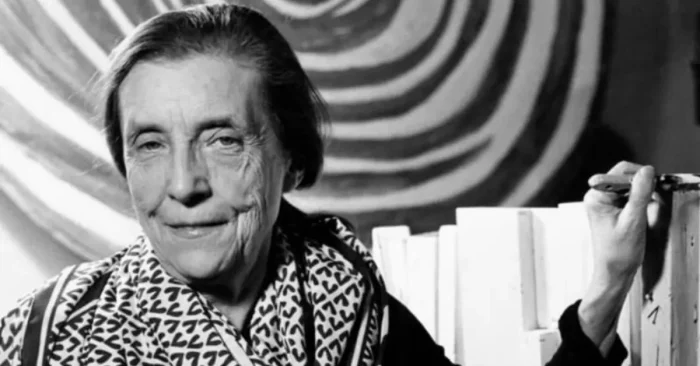
Louise Bourgeois – Biography
Early Life and Education of Louise Bourgeois
Louise Bourgeois was born on December 25, 1911, in Paris, France. She grew up in a household deeply connected to art and craftsmanship, with her parents running a tapestry restoration business. From an early age, Bourgeois helped restore and draw designs for tapestries, shaping her lifelong engagement with textiles. Her childhood was also marked by emotional turmoil. Her father’s infidelity and complex family dynamics left psychological scars she would address in her art for decades. She began studying mathematics at the Sorbonne, but after her mother’s death in 1932 she shifted to art, enrolling in schools such as the École des Beaux-Arts and the Académie de la Grande Chaumière.
Move to New York and Early Career
In 1938, Bourgeois married American art historian Robert Goldwater and moved to New York City, a turning point for her life and career. In the United States, she immersed herself in the vibrant art scene, raising three sons while exploring different media. She initially worked in painting and printmaking, but soon gravitated to sculpture, a medium she felt could better express her complex emotions. During the 1940s and 1950s, she produced works addressing domesticity, family, and memory, though she remained relatively unknown outside the art world’s inner circles during these early years.
Breakthrough in Sculpture and Artistic Evolution
By the late 1960s and early 1970s, Bourgeois fully embraced sculpture as her primary language. Works from this period often featured organic, biomorphic shapes and motifs such as spirals, cages, and cells, symbolizing her internal struggles. She addressed sexuality, femininity, vulnerability, and the complexities of family relationships; her art resonated with the feminist movement, though she resisted being boxed as a feminist artist. She preferred to focus on the personal and psychological dimensions of her work, which transcended labels and connected with a broad audience.
Her broader influence extends beyond feminist discourse; for example, contemporary sculptors such as Jeff Koons have cited Bourgeois as an inspiration.
The Spider Series and International Recognition
In the 1990s, Bourgeois gained widespread international recognition, largely due to her monumental “Spider” sculptures. These massive, looming figures—some standing over 30 feet tall—became iconic symbols of her work. The spider, for Bourgeois, represented her mother: a weaver, protector, and restorer, but also a complex, fragile figure. Her most famous spider, titled “Maman,” was unveiled in 1999 and has multiple versions installed in museums and public spaces around the world, further cementing her global reputation as a leading figure in contemporary sculpture. These works are celebrated for their emotional honesty and striking visual language. These powerful pieces solidified Bourgeois’s reputation as a leading figure in modern sculpture, admired for her emotional honesty and striking visual language. Her influence extends to later generations of artists, including contemporary painter Jenny Saville and sculptor Jeff Koons.
Multiple versions of “Maman” are installed in museums and public spaces around the world, underscoring the work’s universal appeal and Bourgeois’s place in art history.
Later Years and Continued Creativity
Even in her later years, Bourgeois remained incredibly productive, continuing to create new work well into her 90s. She often revisited earlier themes, producing installations, drawings, and sculptures that explored psychological landscapes and personal narratives. Her “Cells” series, which began in the late 1980s, consisted of large-scale installations that allowed viewers to peer into intimate, enclosed spaces filled with symbolic objects, evoking feelings of memory, isolation, and introspection. Despite advancing age and declining health, Bourgeois maintained a rigorous studio practice, finding solace and purpose in her art until her passing. Her explorations continued to influence how artists think about space, memory, and embodiment, inspiring a wide range of contemporary practices.
Her Cells installations expanded the vocabulary of installation art, inviting viewers to inhabit intimate psychological landscapes and engage with memory in tactile ways. For readers interested in broader conversations around innovative biographies in the arts, see other artist biographies in our collection as well.
Personal Life and Personality
Throughout her life, Bourgeois was known for her sharp intellect, emotional intensity, and candid approach to her personal struggles. Her marriage to Goldwater lasted until his death in 1973, providing her with a stable home life even as she grappled with psychological issues stemming from her childhood. Bourgeois openly discussed her battles with anxiety, depression, and the lingering impact of her early experiences, often stating that creating art was a form of therapy for her. She welcomed younger artists and visitors to her home studio in Chelsea, New York, offering mentorship and conversation well into her later years.
Legacy and Influence
Louise Bourgeois passed away on May 31, 2010, at the age of 98, leaving behind a vast and deeply personal body of work. Her influence on contemporary art is profound. She is celebrated for breaking boundaries, merging deeply personal content with innovative sculptural forms. Her willingness to confront taboo subjects like trauma, sexuality, and vulnerability has inspired generations of artists, particularly women, to explore their inner worlds through art. Bourgeois’s work continues to be exhibited globally, and her “Spider” sculptures remain among the most iconic symbols of emotional strength and complexity in modern art.
Today, Bourgeois’s works are held in major museums worldwide, and her Spider sculptures continue to draw new generations of viewers. For readers exploring other biographies in our collection, consider Léa Seydoux Biography.
Conclusion
Louise Bourgeois’s life and art were defined by her courage to confront personal pain and transform it into powerful, universally resonant works. From her early days in Paris to her international acclaim in New York, she remained deeply connected to her emotions, using her art as both expression and healing. Today, her legacy endures as a testament to the power of vulnerability and the enduring impact of honest, fearless creativity. Her influence continues to be recognized across contemporary art, and her works remain central to major museum collections worldwide.
Frequently Asked Questions (FAQs)
What is Louise Bourgeois best known for?
She is best known for her large “Spider” sculptures, especially “Maman,” symbolizing motherhood and protection.
What themes did Louise Bourgeois explore?
Her work often explored trauma, memory, family, sexuality, and psychological vulnerability.
Where did she study art?
She studied at several Parisian institutions, including École des Beaux-Arts, before moving to New York.
Was Bourgeois part of any specific art movement?
Though often associated with feminism and surrealism, she resisted strict categorization, focusing on personal expression.
When did Louise Bourgeois pass away?
She passed away on May 31, 2010, at the age of 98.