
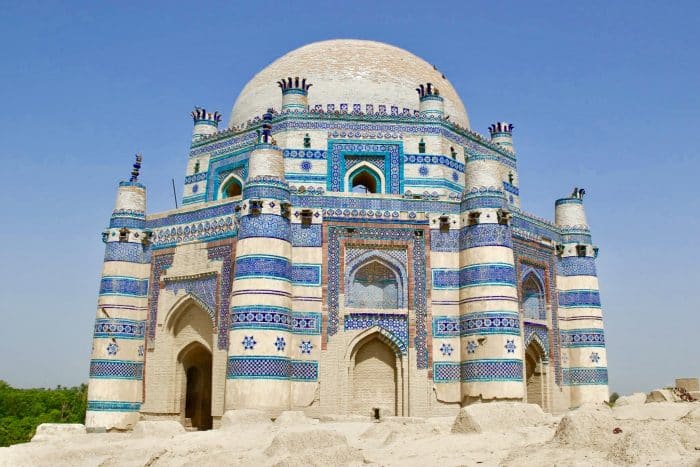
Uch Sharif Overview
Uch Sharif is a historic town in the Punjab region of Pakistan, located about 75 km southeast of Bahawalpur. It is often linked to the historic name Alexandria on the Indus, a town associated with Alexander the Great’s invasion of the Indus Valley. For more ideas on Pakistan’s historic sites, see Visiting Places in Pakistan.
Visiting places in Uch Sharif
- Darbar, Hazrat Sayed Jalaludin Bukhari R.A
- Tomb of Bibi Jawindi
- Tomb of Nuria
- Tomb of Bahawal Haleem
- Head Punjnand
Darbar, Hazrat Syed Jalaluddin Bukhari
Jalaludin Bukhari (c.595-690 AH, 1199–1291 CE) was a Sufi saint and a revered missionary. He was a follower of Baha-ud-Din Zikriyya of the Suhrawardiyya order. Born in Bukhara, a region that is today part of Uzbekistan, Sayed Jalaluddin Bukhari was a sayed (a direct descendant of the Prophet Muhammad, PBUH) and a renowned Sufi saint. He arrived in Uch Sharif around the age of 95 on the 19th day of Jumada-al-Awwal, 690 AH (22 May 1291 CE). He is known by several names and titles.
- Azim Ullah (Azim of Allah)
- Hassan Jalaluddin
- Jalal Akbar
- Jalal Azam
- Sher Shah
- Sher Shah Jalaluudin
Bukhari was known as a red-clad saint because he often wore a red mantle.
Uch Sharif’s mausoleums are among Pakistan’s notable historical sites. Top 10 Visiting Places in Pakistan highlight these remarkable tombs and their architectural heritage.
Tomb of Bibi Jiwandi
The Tomb of Bibi Jawindi is a historical site in Uch Sharif. The tomb sits about 2 km from the China–Pakistan Road. Her original name was Jindwadi. She belonged to the Bukhari family and was the great-granddaughter of Jahanian Jahan Gusht, a famous Sufi saint. The tomb stands in the northwest corner of Uch Sharif on a low hill, near the site of an old fort. Amid the ruins of architecturally significant tombs, including Ustad Nuria and Baha al-Halim, the tomb honors Bibi Jawindi, the celebrated saint.
The Tomb of Nuria
The tomb was built in the 15th century AD. It is believed to be the tomb of the architect who built the adjoining two tombs. Nuria tomb is raised on a square base surrounded by an octagonal drum and originally had a single dome. It has two entrances, one on the south and the other on the north. The base of the Nuria dome features arched openings at cardinal points. The tomb is faced with glazed tile created with tile mosaic.
The Tomb of Bahawal Haleem
The Tomb of Baha al-Halim stands in the northwest corner of Uch Sharif on a low hillside, the site of an old fort, amid ruins of several other architecturally significant tombs, including Ustad Nuria and Bibi Jawindi. The exact date of construction or its sponsor is not known, but it is commonly ascribed to Jahaniyan Jahangasht (1307-1383), a pupil of Baha al-Halim and a Sufi saint in his own right. The tombs sit in a state of partial ruin; major flooding in 1817 caused the collapse of the west side of the tomb and damaged nearby structures. The tomb is built of fired bricks on an octagonal base with turrets at each corner of the octagon. A single dome rises above a smaller octagonal drum with arched windows.
Even though the tomb has partially collapsed, its symmetrical design makes it straightforward to visualize its original layout. The layout of the tomb is quite similar to that of the mausoleum of Shah Rukn-e Alam in Multan, which was built between 1320 and 1324. Although this design appears common today, the tomb of Rukn-e-Alam and its successors at Uch Sharif were among the first tombs with an octagonal base built on the subcontinent.
Head Punjnand
Head Panjnad (Panjnad Barrage) (Urdu: پنجند) (panj = five, nadi = river) is a river head in Punjab, Pakistan. Panjnad River is formed by the successive confluence of the five rivers of Punjab, namely Jhelum, Chenab, Ravi, Beas and Sutlej. Jhelum and Ravi join Chenab, Beas joins Sutlej, and then Sutlej and Chenab join to form Panjnad near Uch Sharif. The combined stream runs southwest for approximately 45 miles and joins the Indus River at Mithankot. The Indus continues into the Arabian Sea. A dam on Panjnad has been erected; it provides irrigation channels for Punjab and Sind provinces south of the Sutlej and east of the Indus rivers. As part of Punjab’s river heritage, Panjnad is among Pakistan’s notable visiting places. Visiting Places in Pakistan.