
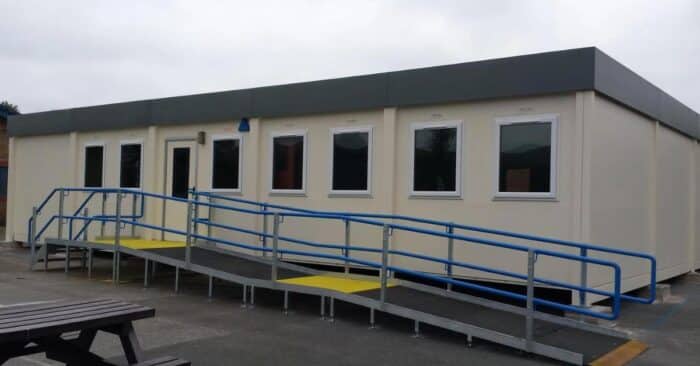
The construction of temporary school buildings has become a common practice in many parts of the world, a trend accelerated by the COVID-19 era as authorities require more learning spaces and promote social distancing.
When a school plans to construct new temporary buildings, it is important to make the right decisions to enjoy all the benefits of the solution. Whether a school is new to these structures or not, this article will be invaluable.
Types of Temporary School Buildings
Depending on the budget and preference, schools can construct a variety of temporary structures through a reliable solution provider. Here are the most popular options.
Portable classrooms
These are constructed offsite and lifted to the school compound. Small portable classrooms are made of shipping containers or modular boards and come fitted with amenities. For more on prefab options, see our guide to prefab warehouses.
Modular temporary school buildings
These are prefabricated structures such as temporary steel classrooms, industrial tents, and clear span structures. A school buys and uses them for various purposes such as learning or for sports. For more on steel frame approaches, see our article How steel frame buildings provide superior protection and are sustainable.
Customized
If a school wants bespoke solutions tailored to their needs, they should consider customized temporary buildings that can fit between existing structures or into tight corners on campus.
How to Construct Temporary School Buildings
When schools find the right temporary school building solution provider, the process of construction becomes easy. For guidance on modern construction approaches, check out our a step-by-step guide to modern construction in 2024.
The school should know what they need so it becomes easy to discuss the possible solutions with a constructor. Of course, these professionals will give options for the school to choose from.
After agreeing on the solution, the experts will visit the school to assess the site. This makes it possible for them to fabricate classrooms and other temporary structures that will suit the space needs of the school.
The last step is assembling or erecting the temporary school buildings on the site. The approach is determined by the type of structures and their size. Small portable classrooms are lifted and placed on the school compound while large temporary halls are assembled on the compound.
Reasons for Using Temporary School Buildings
There are many benefits and reasons why schools prefer to use temporary school buildings. According to experts, the education sector has embraced these structures because they save money and time. First, they are made of affordable temporary materials that are fabricated using modern sustainable innovations. Second, it takes a short time to fabricate and erect these structures in schools. Some are ready to buy and use immediately.
Schools also prefer to construct temporary school buildings because they are versatile and flexible. For instance, school halls can be converted into examination rooms, study areas, and so forth. Likewise, portable classrooms could become libraries or practical halls through a few modifications.
Lastly, the temporary school buildings are beneficial to schools because they meet structural standards. Whether they are made in the UK, USA, Canada, or any other part of the world, manufacturers ensure that they meet the structural standards set by the authorities. These companies are licensed to practice, which ensures that they provide solutions that meet the standards. Furthermore, these structures are sustainable and environmentally friendly, especially those that promote the use of recycled materials. For furniture considerations, see our Complete Guide to Shopping for Classroom Chairs.
Final Words
Is your school looking for a structural solution? Temporary school buildings have many benefits for the school and students. Hence, they are worth considering, and the top secret is to work with professional manufacturers and sellers. Any school that has embraced the use of these structures can confirm that they are durable and require less maintenance as opposed to permanent structures. For broader context on modern construction practices, see our a step-by-step guide to modern construction in 2024.
– If you are looking for guest posts in education “write for us” now.